
 Excavator
294 models
Excavator
294 models  Backhoe Loader
51 models
Backhoe Loader
51 models  Crane
68 models
Crane
68 models  Concrete Mixer
79 models
Concrete Mixer
79 models  Wheel Loader
54 models
Wheel Loader
54 models  Compactor / Roller
45 models
Compactor / Roller
45 models  Motor Grader
42 models
Motor Grader
42 models  Dozer
41 models
Dozer
41 models  Concrete Pump
66 models
Concrete Pump
66 models  Skid Steer Loader
11 models
Skid Steer Loader
11 models  Telehandler
13 models
Telehandler
13 models 


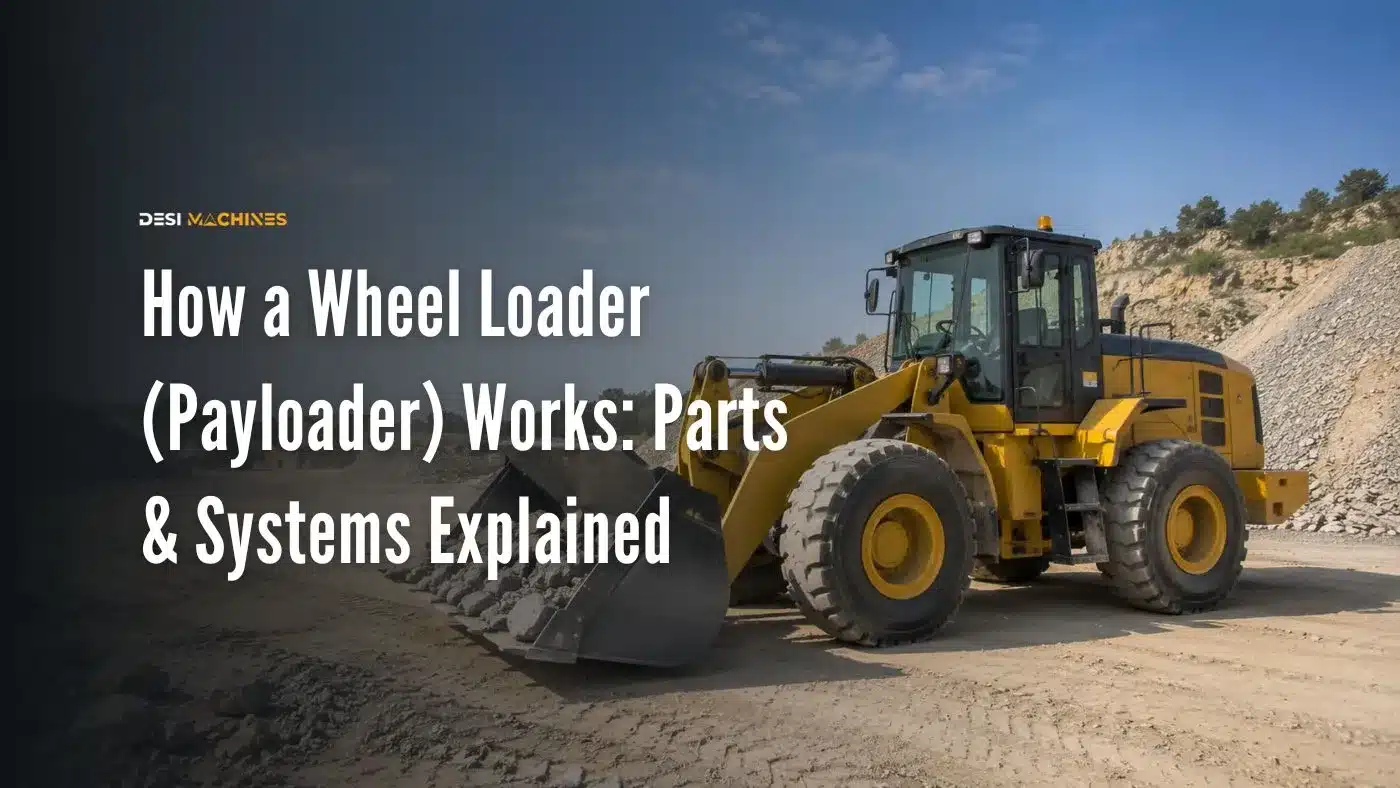
A wheel loader is the big yellow machine you see scooping up sand, gravel or loose soil and tipping it into a truck. On most Indian sites people call it a payloader. It works in a simple loop: it drives its wide front bucket into a pile, the arms lift the loaded bucket up, the machine reverses and drives to the truck, then the bucket tips forward and drops the material. Do that again and again, and a wheel loader can fill a tipper in a few minutes.
That is the short answer. But if you are buying your first machine, it helps to know how each part does its job: the bucket, the lift arms, the hydraulics that give the power, and the joint in the middle that lets it turn in tight spaces. This guide explains all of it in plain language, with current Indian prices for every machine it names.
What Is a Wheel Loader (Payloader)?
A wheel loader is a four-wheeled machine built to pick up loose material and move it a short distance. It has a large bucket at the front, two strong arms to raise that bucket, and rubber tyres so it can drive around a site quickly.
Across India the same machine goes by many names: payloader, pay loader, wheel loader, or just “loader”. They all mean the same thing. The word “payloader” started as a brand name decades ago and stuck, the way people say “JCB” for a backhoe. So if a dealer says payloader and the brochure says wheel loader, do not get confused. It is one machine. If you want the naming difference set out on its own, the payloader vs wheel loader guide covers it in more detail.
What a wheel loader is good at is loading: filling trucks, feeding a crusher at a stone quarry, stacking material, or clearing a big heap. If you are looking at a second-hand machine, the used wheel loader buying guide covers the checks, hour bands and papers that matter. It is not a digging machine like an excavator. Its bucket scoops from a pile that is already loose or from ground it can push into. It does not dig deep trenches. Knowing that one difference saves many buyers from picking the wrong machine.
How a Wheel Loader Works: The Load-and-Carry Cycle
Everything a wheel loader does comes down to one repeating cycle. Operators call it the load-and-carry cycle, and it has four simple stages:
- Dig in / fill. The operator lowers the bucket flat to the ground and drives the machine forward into the pile. The forward push of the wheels forces the bucket to fill with material.
- Lift and curl. Once full, the arms raise the bucket and the bucket “curls” back so nothing spills. The load is now held high and tight.
- Carry / reverse. The machine reverses out, turns, and drives to the truck or the dumping spot with the load carried in front.
- Dump. The arms lift to truck height and the bucket tips forward, letting the material fall into the tipper. Then the machine backs up and starts again.
A smart operator drives this in a tight “V” pattern (pile to truck and back) instead of long straight runs. The shorter the V, the more loads per hour and the less diesel burned. On a well-run site one loader can keep two or three tippers moving.
The Main Parts of a Wheel Loader
A wheel loader looks big and complex, but it is really a handful of parts working together. Here are the main ones and what each does.
How high those lift arms carry the bucket, and how far forward it reaches at full height, is set out in the guide to wheel loader dump height and reach. What keeps the engine, the hydraulics and the transmission from overheating is a separate stack of coolers behind one fan, set out in the guide to the wheel loader cooling system and radiator care.
| Part | What it does |
|---|---|
| Bucket | The scoop at the front that holds the material. Buckets come in different widths and capacities; a bigger bucket moves more per pass but needs a bigger machine to lift it. |
| Lift arms (boom) | The two thick arms that raise and lower the bucket. They carry the full weight of the load, so they are the strongest steel on the machine. |
| Hydraulic cylinders | The shiny rods you see near the arms. One pair lifts the arms; another tilts (curls) the bucket. Hydraulic oil under pressure pushes these rods, and this is where the muscle comes from. |
| Articulated chassis | The body is in two halves joined by a pivot in the middle. This joint lets the machine bend to steer (explained below). |
| Engine | Usually a diesel engine at the rear. It powers both the wheels (to drive) and the hydraulic pump (to lift). The rear engine also acts as a counterweight to balance the heavy load in front. |
| Transmission | Sends engine power to the wheels and controls speed and direction. Most site loaders use a powershift or hydrostatic transmission for smooth forward-reverse shuttling; the wheel loader transmission types guide compares the two and lists which machines use which. |
| Tyres | Large rubber tyres take the load and grip the ground. Good tyres give traction (grip) so the bucket can push into a pile without the wheels spinning. |
| Cab with ROPS | Where the operator sits. ROPS (Roll-Over Protective Structure) is a safety cage that protects the operator if the machine tips. |
If you want a deeper look at how these components are built and maintained, the companion guide to excavator components and how they work covers the same hydraulic and engine ideas in more detail, and most of it applies to loaders too.
How the Hydraulics Give the Machine Its Power
The single most important system on a wheel loader is its hydraulics. This is what lets a machine weighing several tonnes lift a full bucket of gravel as if it were nothing.
Here is the idea in plain terms. The engine drives a pump. The pump pushes hydraulic oil at very high pressure through pipes to the cylinders on the arms. When oil is forced into a cylinder, it pushes the rod out, and that pushing motion raises the arms or tilts the bucket. When the operator moves a lever in the cab, a valve simply decides which cylinder gets the oil, and in which direction.
Because oil does not squeeze, all that engine force passes straight to the arms. That is why a small movement of a joystick can lift a heavy load smoothly. It also means clean oil and healthy hoses matter a lot. A leaking hose or a worn seal takes the lifting power away even while the engine runs perfectly, so keep the oil clean and the machine keeps working.
Articulated Steering: Why It Bends in the Middle
Watch a wheel loader turn and you will notice something odd: the whole machine folds in the middle, like a bus bending around a corner. This is called articulated steering, and it is a clever design.
Instead of turning the front wheels like a car, a wheel loader has a pivot joint between its front and rear halves. Two hydraulic cylinders push the front half left or right around this joint. Because the front bucket and the rear wheels follow the same path, the machine can turn very sharply in a small space. That is a big help on crowded Indian sites where there is little room between the pile and the truck.
Articulated steering also means the front wheels always point where the bucket points, so the operator can drive straight into a pile and steer without losing grip. It is one of the reasons a wheel loader is faster than a rigid machine for repeat loading work.
How to Tell a Wheel Loader Is Working Well
Once you understand the parts, you can judge a machine by watching it load. Three things tell you a wheel loader is in good shape:
- Breakout force. This is how hard the bucket can push into a pile and lift out. A healthy machine fills its bucket in one clean pass without the engine straining. If it takes two or three tries to fill, the hydraulics or the operator technique need a look. Tyre condition is part of the same read, and our guide to wheel loader tyre sizes and types explains what the sidewall code tells you.
- Wheels that grip, not spin. When the bucket goes into the pile, the tyres should hold and drive the bucket in. Spinning wheels mean lost traction (grip), usually from worn tyres or too much throttle. Spinning wastes diesel and eats tyres, which are a big running cost.
- Cycle time. A quick, smooth pile-to-truck-and-back loop is the sign of a well-matched machine and a good operator. Count the loads per hour. That number, not the brochure, tells you the real output.
For a small contractor, these three checks matter more than any single spec on paper. A machine that fills in one pass, grips well and cycles fast will earn its EMI back faster than a bigger machine that struggles on your site.
Wheel Loader vs Backhoe vs Excavator: A Quick Difference
First-time buyers often mix these up, so here is the short version:
- A wheel loader (payloader) is a loading machine, best for scooping loose material and filling trucks fast. It does not dig deep.
- A backhoe loader (the classic JCB) is a two-in-one: a front loader plus a digging arm at the back. Slower at loading, but it can dig.
- A skid steer loader is a small, nimble loader for tight spaces and mixed work with many attachments.
If your work is mostly moving heaps of sand, aggregate or crushed stone into trucks all day, a wheel loader is usually the right tool. If you also need to dig, look at a backhoe instead. The full wheel loader guide and the breakdown of wheel loader size classes help you match the machine to your load size. For the whole loader family in one place, see the complete loaders guide.
What a Wheel Loader Costs in India
Price follows the size class, not the badge. A compact loader for a small yard, a small-class machine for steady truck-loading and a medium machine for bulk work are three different budgets, and the guide to wheel loader size classes explains where each one fits.
Compact machines are the entry point. The ACE ALN 100, at 4,000 kg (4 Ton) with a 1.0 m³ (1,000 litre) bucket, is the cheapest wheel loader we currently list a price for, at roughly ₹19–22 Lakh (indicative, as of October 2026). One step up, the Liugong 818N (5,610 kg, 1.2 m³) runs about ₹35–37 Lakh (indicative, as of October 2026).
Small-class machines (8–15 Ton) are what most contractors actually buy for filling tippers all day. Across the 12 small-class machines we list, buckets run from 1.5 to 3.5 m³ and engines from 121 to 160 HP. Five of the priced ones:
| Machine | Operating weight | Bucket capacity | Indicative price (Oct 2026) |
|---|---|---|---|
| Tata Hitachi TL340H Prime | 10,980 kg | 1.8–2.7 m³ | ₹47–49 Lakh |
| Hyundai HL930I | 10,600 kg | 1.7–3.0 m³ | ₹48–50 Lakh |
| Hyundai HL630I-V | 10,810 kg | 1.8 m³ | ₹48–50 Lakh |
| Hindustan 2021E | 11,637 kg | 1.53–3.0 m³ | ₹51–53 Lakh |
| L&T 9020 | 11,500 kg | 1.5–3.5 m³ | ₹53–55 Lakh |
All five figures are indicative, as of October 2026.
Medium machines (15–30 Ton) move into a different price class altogether. The CAT 950GC, at 18,849 kg with a 2.9–4.4 m³ bucket, is listed at about ₹1.2–1.4 Crore (indicative, as of October 2026).
Above that, most of the large range (the Volvo L-series, the Komatsu WA-series, Liebherr and the bigger Caterpillar models) is quoted on request, because the price moves with the bucket, tyres and options you choose. Treat every figure here as a starting point, not a final quote.
One thing worth knowing before you compare quotes: the prices above are ex-factory. A wheel loader is a registrable machine, so the on-road figure adds transportation, RTO registration, TCS, warranty and insurance on top. Tax is not added a second time.
Buying on EMI is common for loaders. To work out a monthly figure, the equipment finance and EMI options page lays out the loan side, and equipment insurance cover protects the machine once it is yours. To see the full live range and get a quote, browse all wheel loaders on DesiMachines.
The scoop matters as much as the machine: see wheel loader bucket types and sizing to match the right bucket to your material.
For the volumes that keep those systems filled, see the guide to wheel loader fuel tank and oil capacities.
If you are hiring rather than buying one, rates, bucket sizing against your tipper and the handover checks are set out in the wheel loader on rent guide.
For a deeper look at each of those parts on its own, including the axles, brakes and steering hardware, read the guide to wheel loader parts and components.
For the numbers behind that fill test, see our guide to wheel loader breakout force and tipping load, which gives the published spans across every machine we list.
The articulated joint is also what sets the machine’s turning circle, and that figure sits alongside width, height and ground clearance in wheel loader dimensions.
What those hydraulics actually run at, and what to check when they stop working properly, is set out with the published pressure and flow figures in the guide to wheel loader hydraulic problems.
Because the articulation is powered entirely by hydraulics with no mechanical backup, a steering warning on the dashboard means stop where you are; what that lamp and the others mean is explained in our guide to wheel loader warning lights.
How much engine power each class actually carries is set out in the wheel loader engine power and torque guide.
Prices, specifications and features are indicative, vary by variant, location and date, and should always be confirmed with the official OEM or authorised dealer before any purchase decision. DesiMachines is not liable for decisions taken on the basis of information that may have changed after publication.

