
 Excavator
294 models
Excavator
294 models  Backhoe Loader
51 models
Backhoe Loader
51 models  Crane
68 models
Crane
68 models  Concrete Mixer
79 models
Concrete Mixer
79 models  Wheel Loader
54 models
Wheel Loader
54 models  Compactor / Roller
45 models
Compactor / Roller
45 models  Motor Grader
42 models
Motor Grader
42 models  Dozer
41 models
Dozer
41 models  Concrete Pump
66 models
Concrete Pump
66 models  Skid Steer Loader
11 models
Skid Steer Loader
11 models  Telehandler
13 models
Telehandler
13 models 


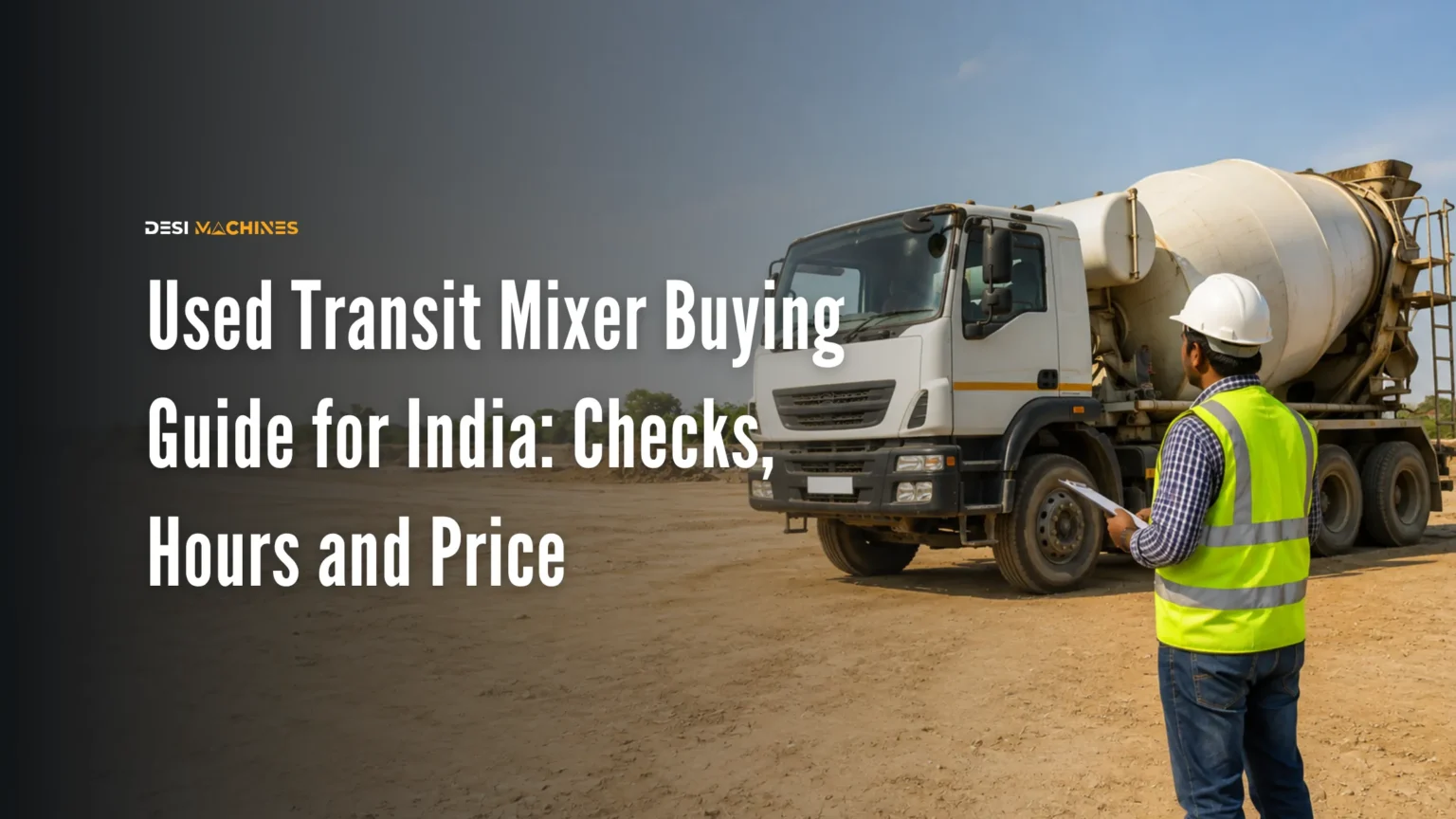
A used transit mixer is really two second-hand machines bolted together: a truck chassis that has done its kilometres, and a mixer drum that has done its loads. They wear out separately, they are repaired by different people, and a machine can be sound on one and finished on the other. That is the single most useful thing to understand before you look at one.
New truck-mounted transit mixers listed on DesiMachines run from ₹33.50 – 37.50 Lakhs up to ₹55.50 – 57.50 Lakhs (indicative, as of Aug 2026), and a used machine is priced down from the band for its own class. This guide covers what to inspect on both halves, how to read the hours and kilometres, the papers a registered vehicle must come with, and how to work out a fair price.
What should you check on a used transit mixer?
Inspect the drum first, because drum work is the expensive surprise and the seller knows it. Get inside with a torch and look at the blades, the spiral fins welded to the drum wall that lift and fold the concrete. They wear thin from abrasion, and worn blades stop mixing properly long before they look dramatic. A drum that no longer mixes evenly gives you segregated concrete at the pour, which is a rejected load, not a small problem.
Then look for hardened concrete build-up. Every mixer collects some, but a drum that has been washed carelessly for years carries a thick shell of set concrete. That shell is dead weight the machine carries all day, it eats into the drum’s usable capacity, and chipping it out is slow manual work. Check the published capacity against what the seller says the drum actually takes.
On the chassis side, treat it as you would any used commercial vehicle. Check the engine for smoke and oil leaks, the gearbox and clutch, the suspension and the tyres, and look hard at the chassis frame behind the cab, where a mixer’s constant off-centre load shows up as cracks. Ask to see it loaded if you can, since a mixer that is fine empty can reveal a tired suspension the moment 8 cubic metres of concrete goes in.
Three more things people forget. The water tank and washout system, without which the drum cannot be cleaned at the end of a run. The chutes, which get bent and worn and are cheap to replace but tell you how the machine was treated. And the drum rollers and thrust bearings the drum turns on, which are a real repair bill if they are noisy. The general checks in the used equipment inspection checklist apply on top of these.
How the drum is driven, and why it matters second-hand
Transit mixer drums are turned in one of three ways, and the choice affects what you are inheriting. A PTO drive takes power from the truck’s own gearbox. A REPTO takes it from the rear of the engine, so the drum can turn with the truck stationary and in gear. A slave engine is a separate small diesel that drives the drum on its own.
Second-hand, each carries a different risk. A slave engine is a whole extra engine to inspect and maintain, and a neglected one is a real cost, but it keeps drum wear off the truck driveline. A PTO or REPTO machine has fewer parts to go wrong, but years of drum duty have gone through the truck’s own gearbox and clutch, so those deserve closer attention. The differences are set out in full in the guide to transit mixer drum drive, PTO, REPTO and slave engine.
Whichever it is, run the drum through a full cycle on the inspection, both directions, empty. Listen for knocking from the rollers, watch for hydraulic leaks at the drive head, and check that it reverses to discharge cleanly rather than hesitating.
How many kilometres and hours is too many?
Read both meters, and be suspicious when only one is offered. The odometer tells you what the chassis has done and the drum hours tell you what the mixer has done, and the two do not move together. A machine on RMC plant duty in a city runs short trips with long drum hours: low kilometres, heavily worked drum. A machine feeding a highway package runs long hauls with fewer batches: high kilometres, an easier drum.
So a low odometer reading on a transit mixer is not the reassurance it would be on a tipper. Ask what work the machine did and check that the story matches both numbers. A city RMC machine with 80,000 km on it may have a more tired drum than a highway machine with double the reading.
What matters more than any threshold is evidence. Ask for the service history, the drum blade replacement record and the details of any chassis repair. A seller who can produce those is telling you something a meter cannot, and a machine with paperwork is worth paying more for than an identical one without it. The step-by-step process in how to buy used construction equipment in India covers how to structure that conversation.
What does a new transit mixer cost in India?
You need the new band before you can judge a used price, because a used machine is priced down from the band for its own class. These are the truck-mounted transit mixers listed on DesiMachines with their prices as shown on each machine, current as of August 2026.
| Model | Engine power | Price (indicative, as of Aug 2026) |
|---|---|---|
| Mahindra Blazo X 28 | 280 HP (206 kW) | ₹33.50 – 37.50 Lakhs |
| Tata LPK 2821.K FE+ RMC | 203 HP (152 kW) | ₹35.50 – 39.50 Lakhs |
| Eicher Pro 6028TM | 210 HP (157 kW) | ₹44.20 – 46.33 Lakhs |
| Ashok Leyland AVTR 2820 6×4 RMC | 197 HP (147 kW) | ₹46.50 – 49.50 Lakhs |
| Tata Signa 2830.K 8 Cum REPTO RMC | 300 HP (224 kW) | ₹47.79 – 54.79 Lakhs |
| BharatBenz 2828C RMC | 280 HP (210 kW) | ₹48 – 52 Lakhs |
| Eicher Pro 6035TM | 260 HP (194 kW) | ₹50.18 – 57.18 Lakhs |
| Ashok Leyland AVTR 2825 6×4 RMC | 250 HP (184 kW) | ₹51.00 – 53.00 Lakhs |
| Tata Prima 2830.K REPTO RMC | 300 HP (224 kW) | ₹51.62 – 53.68 Lakhs |
| Ashok Leyland AVTR 3825 8×4 RMC | 250 HP (184 kW) | ₹55.50 – 57.50 Lakhs |
Read the ladder rather than any single row. The band runs from about ₹33.5 Lakh at the bottom to ₹57.5 Lakh at the top, and what moves a machine up it is drum capacity and chassis size: the 28,000 kg vehicles carry 6 to 9 m³ and the 35,000 kg ones carry 9 to 11 m³. Capacity and load weight by model are set out in the transit mixer capacity guide.
Bare drum units, the mixer body sold on its own to be mounted on a chassis you supply, are quoted on request rather than listed, so treat any second-hand drum-only deal as a negotiation without a public reference price. Browse the current range of concrete mixers for the live figures.
These are ex-factory prices. Because a transit mixer is a registrable vehicle, the on-road cost adds transportation, RTO registration, TCS, warranty, insurance and FOC where applicable, so the amount that actually leaves your account when buying new is above the band. That matters when you compare a used machine’s asking price against a new one.
How much should a used transit mixer cost?
Work down from the new band for that class, then make four adjustments before you compare two machines.
The deferred spend. Add up what you will have to spend in the first six months and take it off the asking price. On a transit mixer that list is usually drum blades, tyres, a clutch or gearbox job, hydraulic hoses at the drive head, and chute repairs. A machine ₹2 Lakh cheaper that needs a set of blades and a clutch is not cheaper.
The emission norm on the engine. This is where age turns into money. On some government and larger contracts the norm on the engine plate decides whether the machine can be deployed at all, and it shapes what you can sell it for later. Check the plate rather than the seller’s word, and read the guide to BS-CEV emission norms before you commit.
Which half is tired. A sound drum on a worn chassis is a different purchase from a sound chassis with a worn drum, and they are not priced the same. Chassis work is available in any district town. Drum and drive repairs need a specialist, so a tired drum should pull the price down harder than the repair estimate alone suggests.
The finance. Used-vehicle loans carry higher rates and shorter tenures than new ones, so two machines at the same headline price can cost very different amounts across the term. Work the full outgo through rather than comparing headline prices, and count the repairs in. First-time buyers are often surprised how small the monthly gap turns out to be against a new machine.
Which papers must come with a used transit mixer?
This is where a transit mixer differs most from a used excavator or roller. It is a registered commercial vehicle, so the paperwork is not optional and an incomplete file can leave you unable to run the machine you have paid for. Ask for all of it before any money moves.
- Registration certificate (RC) in the seller’s name, matching the chassis and engine numbers you can physically read on the vehicle.
- Fitness certificate, valid and current. A commercial vehicle without one cannot legally be on the road, and the guide to fitness certificates for machines explains what the test covers.
- Permit appropriate to where you will run it, national or state.
- Insurance, with the claim history if you can get it, since a heavy claim record tells you something about how the machine was driven.
- Hypothecation NOC from the financier if the vehicle was ever on a loan. A pending hypothecation entry on the RC will block transfer.
- PUC certificate and the tax payment record, both current.
Do the RC transfer properly and promptly. Until it is in your name you are not the owner in any way that matters, and challans and liabilities from the previous owner can follow the vehicle. Budget for the transfer cost and the time it takes rather than treating it as an afterthought.
Is a used transit mixer worth buying?
It is, in two situations. If you have steady, predictable concrete work, a used machine puts a mixer on the road for well under the new band and starts earning immediately. And if you are adding a second or third machine to a fleet that already has a workshop and a driver you trust, the risk of a second-hand purchase is far lower, because you can absorb a repair without stopping the job.
It is a poor idea when the mixer is your first machine and your work is irregular. A transit mixer only earns when there is concrete to carry, and unlike a backhoe it cannot be switched to some other task in a quiet week. If your pours are occasional, hiring a mixer or buying ready-mix delivered is usually the cheaper answer, and the comparison in self-loading mixer versus transit mixer is worth reading first, since a self-loading machine batches its own concrete and suits scattered small jobs far better.
Buyers cross-shopping the second-hand market will find the same exercise for other machines in the used self-loading mixer guide and the used road roller guide, and the pillar page on buying used construction equipment in India covers the ground common to all of them.
Ready to compare? See the current range of transit mixers and concrete mixers with specifications and prices for every model, or read the transit mixer guide for how these machines work before you shortlist a used one. Servicing intervals for whichever machine you buy are in the construction equipment service schedule.
If a part name on the inspection list is unfamiliar, the guide to transit mixer parts and components works through the drum, rollers, sub-frame and water system one by one.
Prices, specifications and features are indicative, vary by variant, location and date, and should always be confirmed with the official OEM or authorised dealer before any purchase decision. Prices shown are taken from our listings at the time of writing. DesiMachines is not liable for decisions taken on the basis of information that may have changed after publication.
Machines, tenders and news for this industry: Ready-Mix Concrete