
 Excavator
294 models
Excavator
294 models  Backhoe Loader
51 models
Backhoe Loader
51 models  Crane
68 models
Crane
68 models  Concrete Mixer
79 models
Concrete Mixer
79 models  Wheel Loader
54 models
Wheel Loader
54 models  Compactor / Roller
45 models
Compactor / Roller
45 models  Motor Grader
42 models
Motor Grader
42 models  Dozer
41 models
Dozer
41 models  Concrete Pump
66 models
Concrete Pump
66 models  Skid Steer Loader
11 models
Skid Steer Loader
11 models  Telehandler
13 models
Telehandler
13 models 


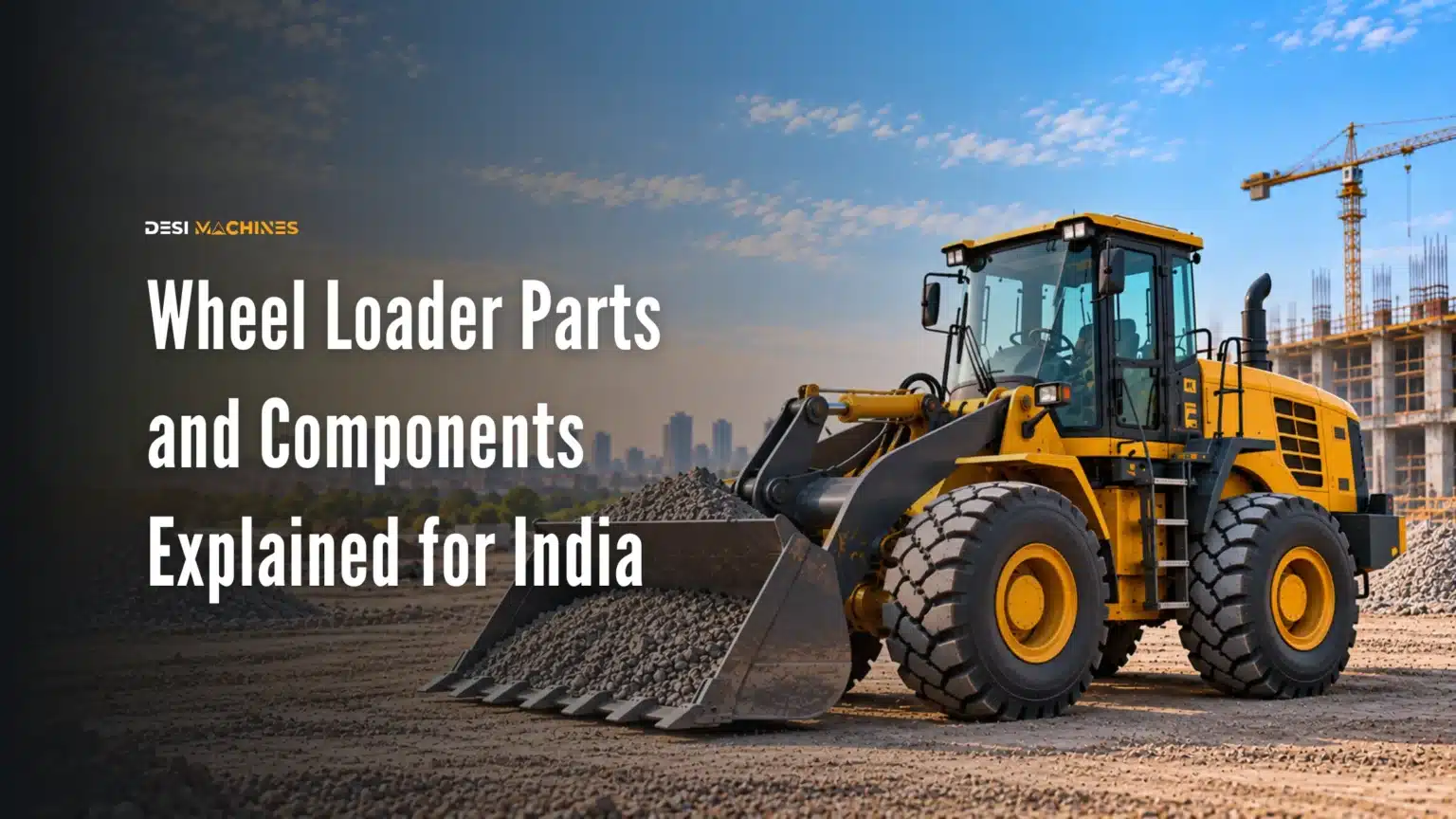
Wheel loader parts fall into four groups. A wheel loader, called a payloader on most Indian sites, is a four-wheeled machine that scoops loose material into a bucket at the front and carries it a short distance, and every part on it belongs to one of four groups: the front loading end that digs and lifts, the power train that turns diesel into wheel movement, the articulated chassis and steering that lets the machine bend in the middle to turn, and the hydraulics and brakes that supply the muscle and stop the machine.
Learn those four groups and a repair estimate stops being a mystery, because a fault in one group is a different job and a different bill from a fault in another. This guide names every part, says what it does, and gives the figures published for the 54 wheel loaders listed for India at the time of writing, across twelve brands: ACE, Cat, Hindustan, Hyundai, JCB, Komatsu, L&T, Liebherr, Liugong, Tata Hitachi, Volvo and XCMG.
What are the main parts of a wheel loader?
Every wheel loader is built from the same four groups. The size changes, the badge changes, the cab gets nicer. The layout does not.
Table 1: The four part groups of a wheel loader
| Group | Parts in it | What the group does |
|---|---|---|
| Front loading end | Bucket, cutting edge and teeth, lift arms, lift and tilt cylinders, linkage, pins and bushes | Digs into the pile, lifts the load, tips it into a tipper |
| Power train | Engine, torque converter, transmission, drive shafts, axles, final drives, tyres | Turns diesel into wheel movement and pushes the bucket into the pile |
| Chassis and steering | Front frame, rear frame, centre hinge pins, steering cylinders, rear axle pivot, counterweight, cab with ROPS | Carries everything, bends in the middle to steer, keeps the machine balanced |
| Hydraulics and brakes | Pump, control valve, oil tank, filters, hoses, service brakes, parking brake | Supplies the lifting force and stops a heavy machine on a slope |
One split is worth carrying in your head: parts that touch the material against parts that touch oil. Anything meeting stone, sand or ore is a wear item you replace on a predictable schedule. Oil-side parts fail instead from dirt, heat and tired seals, which is far less predictable and far more expensive to ignore.
Parts naming carries across machine families, so if you have read the guide to excavator parts or the one on backhoe loader parts, the engine and hydraulic sections will feel familiar. What is different on a loader is the chassis: it is the only common earthmoving machine that steers by folding in half.
What is in the front loading end?
The front loading end is everything ahead of the centre hinge, and it is where a wheel loader earns its money. The bucket is the scoop itself. Along its lip runs a cutting edge, a bolt-on steel bar, and on many machines a row of bucket teeth sits ahead of that. Both are sacrificial: they wear away so the bucket shell does not.
Two thick steel lift arms, often called the boom, carry the bucket, and a pair of lift cylinders raises and lowers them. A separate tilt cylinder, working through a linkage of levers, curls the bucket back to hold material and rolls it forward to dump. Where each of those parts meets another there is a pin running inside a bush, and those pins and bushes are the joints of the machine.
Bucket size is published for all 54 machines and runs from 1.0 m³ on the smallest to 24.5 m³ on the largest mining machine. Which bucket suits which job is covered in the guide to wheel loader bucket types and sizing; the non-bucket tools that fit the same arms are in the guide to wheel loader attachments.
What is in the power train of a wheel loader?
The power train runs from the engine at the back to all four wheels. A wheel loader has to push a bucket into a packed pile, so this group is built for pushing force rather than road speed.
The engine is a diesel, mounted at the rear where it doubles as a counterweight. Of the 54 machines listed, 39 use a six-cylinder engine and 9 use a four-cylinder; four large mining loaders use twelve cylinders and one uses sixteen. Power and torque by size class are in the guide to wheel loader engine power.
Behind the engine sits the torque converter, a fluid coupling of two bladed wheels facing each other inside a housing of oil. It does something a clutch cannot: when the bucket jams in the pile and the wheels stop turning, it lets the engine keep running and multiplies the twisting force instead of stalling. 48 of the 54 machines publish a torque converter specification. Three Liebherr machines do not, and that is correct rather than missing data, because they use a hydrostatic drive in which a pump and a motor connected by oil replace the converter and gearbox entirely.
Next is the transmission, the gearbox. 50 of the 54 use a powershift transmission, which changes gear under load without the operator touching a clutch, essential on a machine that shuttles forward and reverse thousands of times a day. The trade-offs against the four hydrostatic machines are set out in the guide to wheel loader transmission types.
From the gearbox, drive shafts run forward and back to the two axles. Every machine that publishes a drive type is four-wheel drive, all 52 of them, and the reason is simple: a loader driving only one axle cannot push a bucket into a pile without spinning.
Machines built to CEV Stage IV and Stage V emission rules carry one part older machines do not, a DEF tank. DEF, also sold as AdBlue, is a urea solution sprayed into the exhaust to clean it. 16 of the 54 publish a DEF tank size, running from about 16 litres to 60 litres on the Indian-market machines. Moving up from an older machine, budget for keeping DEF in stock and keeping it clean, because contaminated DEF damages the exhaust system.
Why does a wheel loader bend in the middle?
A wheel loader steers by folding at the waist, and the parts that do it are the most distinctive thing about the machine. The body is two separate frames, a front frame carrying the loading end and a rear frame carrying the engine, joined by a vertical centre hinge on two large pins. Two steering cylinders, one each side of that hinge, push and pull the halves against each other.
Because the whole front frame swings, the front wheels follow the same track as the rear wheels through a turn. The bucket goes where the front of the machine points, so an operator can drive into a pile, back out, swing and be square to the tipper in one movement.
How far it bends is published for all 54 machines: from ±35° to ±43°, with ±40° the most common at 18 machines. A machine that articulates ±40° swings through 80° in total, which sets how tight a yard it can work in. Worth measuring against your own site before you buy, not after.
The second angle here is rear axle oscillation. The rear axle is not bolted rigidly to the frame; it hangs on a central pivot so it can rock like a see-saw. Drive one rear wheel over a rock and the axle tilts while the frame stays level, so all four wheels keep their grip. Every one of the 54 machines publishes this figure, from ±8.5° to ±15°, with ±13° the most common.
Behind the rear axle sits the counterweight, a cast iron block that balances the load at the front. Above it is the cab, fitted with ROPS, a Roll-Over Protective Structure, which is a certified steel cage that protects the operator if the machine tips. Never cut, drill or weld a ROPS frame; it stops being certified the moment you do.
What is in the axles and final drives?
Each axle carries a differential in the middle and a final drive at each wheel end. The differential splits power between the left and right wheels; the final drive is a set of planetary gears at the hub that turns high engine speed into the slow, very high torque a loaded wheel needs.
The two axles are mounted differently, and that is the point. Of the 49 machines that publish axle type, 45 describe the front axle as fixed or rigid, bolted solidly to the front frame because that is what the machine pushes against, and 41 describe the rear axle as oscillating, trunnion-mounted or centre-pivoted, the see-saw arrangement above. Seven name a limited-slip differential, which sends power to the wheel that still has grip when the other is spinning in mud.
Final drives share their oil with the axle housing, one of five or six separate oil systems on a wheel loader; which system holds how much is set out in the guide to wheel loader fuel tank and oil capacities. Tyres are the last part of this group and the one you buy most often, running from small 14.00-25 rims on compact loaders up to 58/85-57 mining tyres; the ply and tread codes are explained in the guide to wheel loader tyre sizes and types.
Looking at machines rather than parts? Compare live wheel loader models and prices and talk to a dealer directly.
What kind of brakes does a wheel loader have?
Stopping 20 tonnes of machine with a full bucket on a ramp needs more than a car brake, so wheel loaders use a design most buyers have never met. All 54 machines publish a service brake specification. 37 state a wet, oil-immersed or oil-cooled disc brake, meaning the discs sit sealed inside the axle housing, running in oil that carries the heat away. Because they are sealed, site dust and water never reach them, and they routinely last the life of the machine.
Three machines state a dry disc brake, and the remaining 14 describe how the brake is worked, such as air-over-hydraulic or caliper, without saying wet or dry. If the sheet does not say, ask the dealer: a wet brake is a genuine running-cost advantage in Indian conditions.
The parking brake is a separate part, usually on the transmission output shaft rather than at the wheels. Of the 54, 22 use a spring-applied brake, held on by a heavy spring and released by hydraulic pressure, so it locks automatically the moment the engine stops or a hose fails; 11 use a drum or expanding-shoe type. A spring-applied parking brake that will not release is almost always a pressure problem, not a brake problem.
What does the hydraulic system contain?
The hydraulic group is the machine’s muscle. A hydraulic pump, driven off the engine, pushes oil under pressure through a control valve that the joystick moves, and out to the lift and tilt cylinders. Oil returns to a tank through filters that catch the metal and dirt that would otherwise destroy the pump.
Of the 51 machines publishing a system type, 38 use a load-sensing system and 8 use an open-centre system. The difference shows up in the diesel bill: a load-sensing system supplies only the oil the operator is actually asking for, while an open-centre system keeps pumping regardless. On the pump itself, 38 of the 51 use a variable-displacement piston pump and 12 use a simpler gear pump. Piston pumps cost more and pair with load-sensing; gear pumps are cheaper and harder to damage.
System pressure is published on 52 of the 54 machines and runs from 160 bar to 380 bar, with the middle around 280 bar. Two things in that span need reading carefully: the 380 bar top end belongs to the hydrostatic Liebherr machines, where the published figure covers the drive circuit as well as the loading circuit, and Hyundai publishes pressure in MPa rather than bar on two machines, where 18 MPa is the same as 180 bar. Maximum pump flow is published on 44 machines; on the 10 to 20 tonne machines most Indian buyers look at, it sits roughly between 130 and 330 litres per minute.
Which wheel loader parts wear out first in India?
Parts do not fail in a random order. On a loader working sand, aggregate or crusher feed, this is roughly the sequence, fastest-wearing first.
- Bucket teeth and cutting edge. Designed to be consumed; in abrasive material they can go in weeks. Replace them before the bucket shell starts wearing, because the shell is not a bolt-on part.
- Tyres. Usually the single biggest running cost, and mostly decided by how the operator drives. Spinning the wheels against a pile destroys tyres faster than any ground condition.
- Pins and bushes. They wear slowly if greased on schedule and very fast if not. Grease points and intervals are in the guide to greasing a construction machine.
- Filters and oils. Cheap, scheduled, and the first thing most owners skip when work is busy. The hour-by-hour intervals are in the construction equipment service schedule.
- Hydraulic hoses and seals. A cylinder seal weeping for months eventually scores the rod, which turns a cheap job into an expensive one.
- Battery. Flattened by short runs and heat rather than by age; whether your machine takes 12V or 24V is covered in the guide to construction machine batteries.
- Torque converter and transmission. Rarely, and usually because of oil that was overheated or never changed.
Before buying a replacement, the guide to construction equipment spare parts explains which group each part belongs to and what to check before you fit it.
Standing in front of a second-hand machine, this same list is your inspection order: rock the bucket and watch the pin joints, look along the cylinder rods for scoring, steer fully both ways and feel for play at the centre hinge, and read the oils for water, heat or metal. The full routine, including what hour readings mean, is in the used wheel loader buying guide. For how these parts work together during a loading cycle, read how a wheel loader works, and for the buying decision itself, the complete wheel loader guide.
A note on the figures in this guide
Every count and range above was taken from the published specifications of the 54 wheel loaders listed on DesiMachines at the time of writing, and each is given with how many machines publish that field, so you can see how solid the number is.
Two entries were excluded because the published data contradicts itself, and they are named here rather than quietly dropped. One machine publishes an engine displacement in the cylinder-count field, so it is left out of the cylinder counts. Another publishes a hydrostatic transmission and a torque converter together, which cannot both be right, so it is not cited for either. Both have been raised for correction. Specifications also change with model year and variant, so confirm anything critical with the dealer.
Table 2: Wheel loader part specifications published across the 54 machines listed for India
| Part or system | Published specification | Range or split across the listed machines | Machines publishing it |
|---|---|---|---|
| Engine | Number of cylinders | 4 on 9 machines, 6 on 39, 12 on 4, 16 on 1 | 53 of 54 |
| After-treatment | DEF (AdBlue) tank | About 16 to 60 litres on CEV Stage IV and V machines | 16 of 54 |
| Torque converter | Converter type | Mostly single-stage; absent by design on hydrostatic machines | 48 of 54 |
| Transmission | Type | Powershift on 50, hydrostatic on 4 | 54 of 54 |
| Steering | Articulation angle | ±35° to ±43° (±40° most common) | 54 of 54 |
| Rear axle | Oscillation angle | ±8.5° to ±15° (±13° most common) | 54 of 54 |
| Axles | Front and rear axle type | Front fixed on 45; rear oscillating or pivoted on 41 | 49 of 54 |
| Service brake | Brake type | Wet or oil-immersed disc on 37; dry disc on 3 | 54 of 54 |
| Parking brake | Brake type | Spring-applied on 22; drum or shoe on 11 | 54 of 54 |
| Hydraulic system | System type and pressure | Load-sensing on 38, open-centre on 8; 160 to 380 bar | 51 of 54 |
| Hydraulic pump | Pump type | Variable-displacement piston on 38; gear pump on 12 | 51 of 54 |
| Tyres | Tyre size | 14.00-25 on compact machines to 58/85-57 on mining machines | 52 of 54 |
Wheel loader parts, in short
Four groups, and you can place any part on the machine in one of them. The front loading end holds the wear items you replace on a schedule. The power train, meaning engine, torque converter, powershift gearbox, four-wheel drive, axles and final drives, is where the pushing force comes from. The articulated chassis, bending ±35° to ±43° at the centre hinge with the rear axle rocking ±8.5° to ±15°, is what makes a loader a loader rather than a big tractor. And the hydraulics and brakes, load-sensing on most machines and running at 160 to 380 bar, supply the lift and the stopping power.
Tyre size is also what makes the machine wider than its wheel tread, which is the figure that decides whether it fits through a gate — see wheel loader dimensions.
Ready to compare machines rather than parts? Browse the current range of wheel loaders and ask the dealer about anything the specification sheet leaves blank. Indian machines worth putting side by side on these fields include the L&T 9020, the Hindustan 2021E, the JCB 455-5N and the Hyundai HL930I. Prices are shown where the seller lists one and are on request where they do not.
The same series covers telehandler parts and components, the machine most often working beside a wheel loader on the same site.
Prices, specifications and features are indicative, vary by variant, location and date, and should always be confirmed with the official OEM or authorised dealer before any purchase decision. DesiMachines is not liable for decisions taken on the basis of information that may have changed after publication.