
 Excavator
294 models
Excavator
294 models  Backhoe Loader
51 models
Backhoe Loader
51 models  Crane
68 models
Crane
68 models  Concrete Mixer
79 models
Concrete Mixer
79 models  Wheel Loader
54 models
Wheel Loader
54 models  Compactor / Roller
45 models
Compactor / Roller
45 models  Motor Grader
42 models
Motor Grader
42 models  Dozer
41 models
Dozer
41 models  Concrete Pump
66 models
Concrete Pump
66 models  Skid Steer Loader
11 models
Skid Steer Loader
11 models  Telehandler
13 models
Telehandler
13 models 


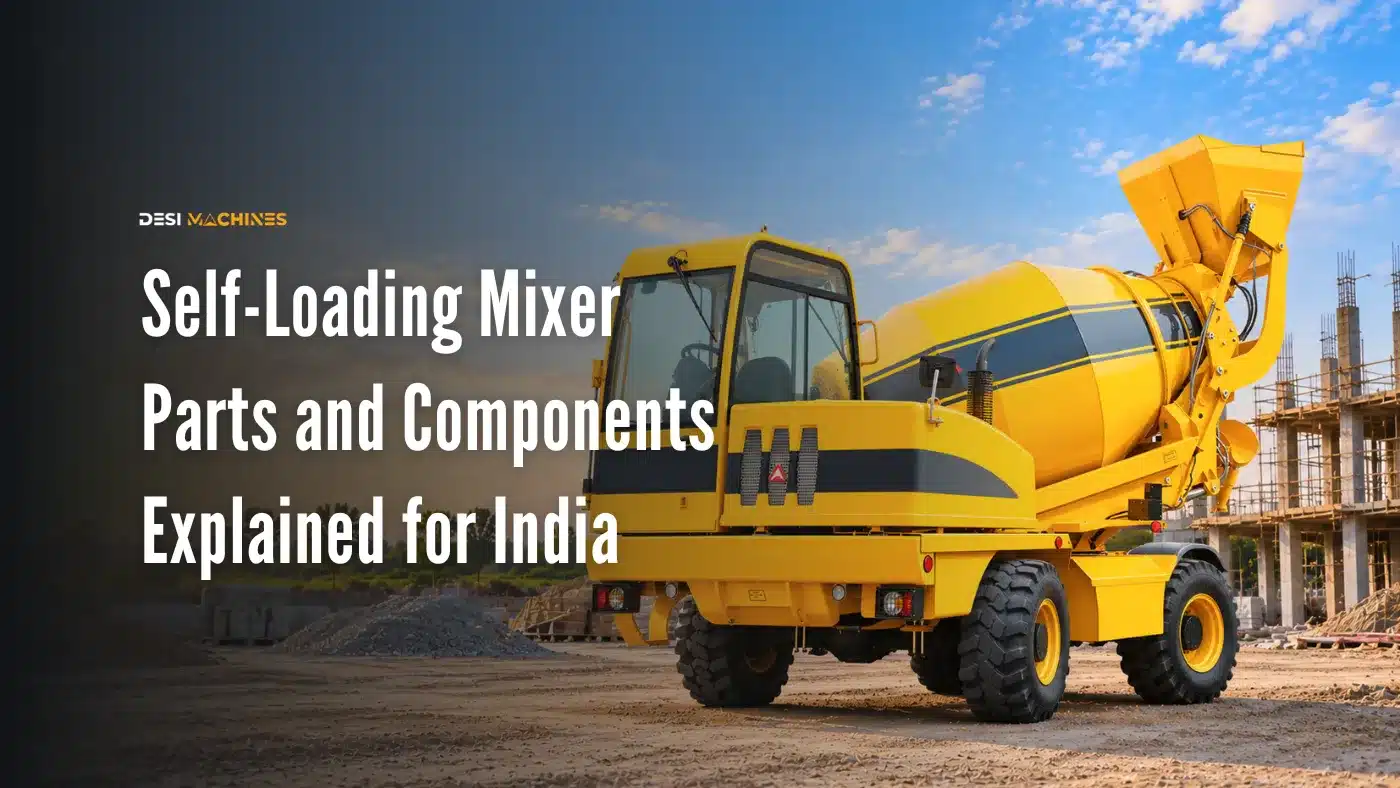
A self-loading concrete mixer is a four-wheel-drive machine that scoops up its own sand, stone and cement, weighs the load, mixes the concrete in a rotating drum and then drives the finished mix to the pour. One operator does the whole job. No separate loader, no batching plant, no transit mixer waiting at the gate.
The main self-loading concrete mixer parts are the mixing drum, the charging bucket that feeds it, the weighing system that decides your mix, the water tank and pump, the diesel engine, the transmission, and the steering and braking system. This guide takes each in turn, using the figures the 38 self-loading mixers listed on DesiMachines publish for themselves.
The short version: the drum decides how much concrete you get per batch, the bucket decides how many scoops fill that drum, and the weighing system decides whether the concrete is actually the grade you asked for.
What are the main parts of a self-loading concrete mixer?
A self-loading mixer is really two machines joined together: a small four-wheel-drive loader at the front and a concrete mixer on the back. Every part below belongs to one of those two jobs.
| Part | What it does | Machines publishing a figure |
|---|---|---|
| Mixing drum | Holds and mixes the concrete. Its size sets your batch size. | 38 of 38 |
| Charging bucket | Scoops sand, stone and cement off the ground and tips it into the drum. | 38 of 38 |
| Weighing system | Weighs each material as it is loaded, so the mix matches the grade. | 31 of 38 |
| Water tank and pump | Carries and delivers mixing water. | 36 of 38 |
| Engine | Runs the machine and turns the drum. | 38 of 38 |
| Transmission | Sends engine power to all four wheels. | 36 of 38 |
| Steering system | Turns the wheels. Many machines offer more than one steering mode. | 38 of 38 |
| Brakes | Stop a loaded machine of 5 to 9.5 tonnes. | 38 of 38 |
Two of these get less attention than they deserve. The weighing system decides concrete quality, and the brakes decide whether the machine is still safe after two monsoons.
How does the mixing drum work, and how fast does it turn?
The drum is a steel bowl with spiral blades welded inside. Turned one way, the blades push material inwards and mix it. Turned the other way, the same blades push the concrete out to discharge. That is why the drum must spin both ways.
Drum sizes run from 2.0 m³ (2,000 litres) on the AJAX ARGO 2000 up to 4.8 m³ (4,800 litres) on the largest AJAX, Schwing Stetter and Apollo machines. The UNIVERSAL SLM – 4 publishes 5.4 m³, and we have asked the maker whether that is drum volume or finished output, so it is left out of the range above. A model badge usually carries the drum size, but not always, which is worth remembering when comparing brands.
Drum rotation speed is published by 36 of the 38, almost all stated the same way: 0 to somewhere between 18 and 22 rpm (rotations per minute). The zero matters more than the top figure. It means the speed is variable, so the operator can turn the drum slowly while loading and faster while mixing. Two machines differ. The Fiori DBS 4300 publishes constant speed, meaning no variable control, and the Bull VMP 4000 publishes a single 21 rpm.
Some drums also swing sideways to place concrete without moving the machine. Only 10 of the 38 publish a drum slewing figure, running 180° to 270°. The rest say nothing, so confirm slewing with the dealer rather than assume it.
How many batches a day this turns into is a separate question, and it is answered with worked numbers in our reference on self-loading mixer output per hour and per day.
What is the charging bucket and how big is it?
The charging bucket, also called the loading bucket, is the shovel at the front. It drops to ground level, scoops aggregate from your stockpile and tips it into the drum. All 38 machines publish a bucket size.
Bucket capacity runs from 320 litres on the AJAX ARGO 2000 to 800 litres on the MACONS MST 4 and MST 4.5. The useful thing is not the bucket size on its own but how it compares with the drum, because that tells you how many scoops fill one batch. Across these machines a drum takes roughly 150 litres of bucket for every cubic metre of drum, so a 4 m³ drum typically needs six to eight scoops.
That ratio varies from about 100 to 300 litres per cubic metre and does not split into neat groups, so treat it as a rough guide. One machine sits well outside the rest: the MACONS MST 2 publishes a 600 litre bucket on a 2.0 m³ drum, which is the same number as its own water tank. We have raised that with the maker and have not used it in any figure above.
A bigger bucket is not automatically better. Every scoop has to be lifted and tipped, so a large bucket on a small drum wastes engine time. The cutting edge along the front lip is a wear part and is meant to be replaced.
How does a self-loading mixer weigh the concrete?
This decides whether you get M20 concrete or something weaker, and it is what buyers ask about least. A batching plant weighs each material on a weighbridge. A self-loading mixer does the same job on a moving machine on uneven ground, in one of two ways.
A pressure transducer measures oil pressure in the hydraulic ram that lifts the bucket. Heavier load, higher pressure. Simple and cheap, but indirect, so ram friction, oil temperature and a machine parked on a slope all affect the reading.
A load cell is a sensor that measures weight directly, the same technology as a weighbridge. It costs more and it is generally the more accurate of the two.
Of the 31 machines that publish a weighing method, here is how they split:
| Weighing method | Machines | Examples |
|---|---|---|
| Pressure transducer or pressure sensor | 17 | Schwing Stetter SLM range (dual pressure sensors), CONMAT CSLM range, Tarle SLM range, VENUS ULTRA 2.0 / 3.0 / 4.0 |
| Load cell | 6 | Apollo Carmix 23 / 30 / 46 FX, JOHN SLCM 2.2 and 4.3, AJAX ARGO 4800 |
| Either, depending on variant | 3 | AJAX ARGO 2500, 3000 and 4500 |
| Stated only as electronic | 4 | MACONS MST range, Bull VMP 4000 |
| Computerised batching with printed certificate | 1 | Fiori DBS 4300 |
Most brands pick one approach and use it across their whole range, so this is a brand decision more than a model decision. AJAX is the exception, moving from a pressure transducer on its smallest machine to a load cell on its largest.
The Fiori DBS 4300 is the only machine here that prints a batch certificate. If you pour for a government department or a builder who may ask you to prove the mix, a printed record is worth real money. For your own small jobs, it is not.
The seven machines publishing no weighing method are not necessarily without one. It simply is not stated, so ask before you buy.
Which engine goes into a self-loading concrete mixer?
All 38 machines name their engine maker, and the answer is unusually one-sided. 34 of the 38 run a Kirloskar engine, listed either as Kirloskar or as KOEL, which is Kirloskar Oil Engines Limited. The remaining four are Mahindra and Escorts units.
For an owner in a small town this matters more than the brand of the machine. A Kirloskar diesel engine has one of the widest service networks in India, parts reach most district towns, and any competent diesel mechanic has worked on one.
Published power runs from 48.4 HP (36 kW) on the VENUS ULTRA 2600 to 112 HP (83.5 kW) on the Apollo Carmix 46 FX, with 36 of the 38 stating a figure. Power tracks drum size closely, because the engine turns a loaded drum and drives the machine up a site ramp at the same time.
Which engine sits in which class of machine is covered in our guide to engine brands in Indian construction equipment.
What moves the machine: transmission, steering and brakes
Every one of the 38 machines is four-wheel drive. There is no two-wheel-drive option in this class, so 4WD is not something you shop for here.
Transmission. 36 of the 38 publish a type and most are hydrostatic, meaning oil pressure drives the wheels instead of gears. That gives smooth, stepless speed control and lets the operator creep forward while loading. A handful publish a four-speed automotive-type gearbox instead, closer to what a truck uses.
Steering. All 38 publish a steering type, but they are not all answering the same question. 27 name a steering mode, usually a three-way system switching between normal two-wheel steering, four-wheel steering for a tighter turn, and crab steering, where all four wheels point the same way so the machine moves diagonally. Crab steering earns its keep when you work alongside a wall or a trench.
The other 11 name only how the steering is powered. Three machines, the Tarle SLM 2200, SLM 3000 and SLM 4300, publish manual mechanical steering with no power assistance named. On a machine of 5 tonnes or more that changes how tiring a full day is, so sit in the seat and turn the wheel before you decide.
Brakes. All 38 publish a brake type, and the split that matters is whether they are sealed. 17 of the 38 publish an oil-bath or wet-disc brake, with the braking surfaces enclosed in oil, away from dust, water and cement slurry. That covers the AJAX ARGO, Apollo Carmix, Tarle, JOHN and UNIVERSAL ranges plus the Bull VMP 4000 and Fiori DBS 4300. The other 21 publish hydraulic service brakes without stating they are enclosed.
The machine works all day in wet cement and abrasive dust, which is exactly what wears open brakes out. Sealed brakes cost more to buy and much less to keep.
Travel speed, slope climbing and ground clearance are covered in our reference on self-loading mixer size, height and climb.
Comparing machines? Browse live self-loading concrete mixer models and prices and talk to a dealer near you.
Which parts wear out first on a self-loading mixer?
A self-loading mixer works in wet concrete, one of the hardest environments any machine faces. These parts go first.
- Drum blades and drum liner. The spiral blades wear thin from constant contact with stone. Worn blades mix badly and discharge slowly, and the first sign is a batch that takes longer to come out than it used to.
- Hardened concrete inside the drum. Not a wear part, but the fastest way to ruin one. Concrete left in an unwashed drum sets hard, and every load after that is smaller and heavier. Washing out at the end of every day is the most valuable habit an operator can have.
- Bucket cutting edge. The bolt-on strip along the front lip, far cheaper to replace than letting the bucket itself wear.
- Hydraulic hoses and seals. The bucket, drum and steering all run on hydraulics. Hoses chafe and seals weep where they flex.
- Water pump and nozzles. Cement-laden water blocks nozzles and scores pump internals.
- Brakes. Faster on open brakes than on sealed oil-bath ones.
We do not list spare parts, so we cannot quote a price for any of these, and a made-up figure would be worse than none. Keep your last few invoices for blades, cutting edges and hoses and work out a per-hour figure from what you actually paid. That number is specific to your site and more useful than any published average.
For servicing intervals and what to check when, see our construction equipment service schedule, the guide to hydraulic system maintenance, and the notes on greasing points, grades and intervals. For what to check before you fit a replacement, see the spare parts guide.
What should you check on the parts before you buy?
Whether the machine is new or second-hand, these checks take fifteen minutes.
- Look inside the drum. Blades should have a clean edge, not a rounded, thinned one. Hardened build-up tells you how the previous owner treated it.
- Ask which weighing system is fitted, and ask to see it weigh a bucket load. A load cell and a pressure transducer are not the same thing.
- Check the drum turns both ways and varies in speed, unless it is a constant-speed machine.
- Ask whether the brakes are oil-bath or open. It changes your running costs.
- Try every steering mode, and confirm the steering is powered if that matters to you.
- Run the water pump and watch for a steady spray rather than a dribble.
For a second-hand machine, our used self-loading mixer buying guide covers hours, paperwork and price, and the used equipment inspection checklist covers what applies to any machine. If you are deciding between owning and hiring, see self-loading mixer rental rates.
What does a self-loading concrete mixer cost, and what decides the price?
The price follows the parts, not the badge. We do not print a figure on this page, because the only number that means anything to you is the one a dealer quotes for that variant, in your district, on the day you ask. What you can work out before you ask is where a machine will sit, and the spec sheet you have just read tells you.
What moves the price, roughly in the order it matters:
- Drum capacity. A 4.8 m³ machine is a bigger drum, a bigger engine, heavier axles and bigger tyres than a 2.0 m³ one, so this one choice pulls everything else up with it.
- Weighing system. A direct load cell sits above an indirect pressure transducer, and a computerised batching system that prints a certificate, as on the Fiori DBS 4300, sits above both.
- Brakes. Sealed oil-bath or wet-disc brakes ask more at purchase than open hydraulic service brakes, and much less afterwards.
- Steering. A three-mode system with four-wheel and crab steering sits above plain two-wheel steering, which in turn sits above the manual mechanical steering the three Tarle machines publish.
- Engine. Rated power tracks drum size, and 34 of the 38 machines run a Kirloskar unit, so the engine make is largely settled before you start bargaining.
- The extras that move a quote on an otherwise identical machine: drum slewing, a bigger water tank, a longer warranty.
Self-loading mixers are wheeled and registrable, so transportation, RTO registration, TCS, warranty and insurance land on top of the ex-factory figure. Ask the dealer for the on-road total, not the ex-factory one.
When you ask for a quote, give the dealer four things: the drum size you want, the weighing system, the brake type and your district. Then ask for the on-road total in writing, with the warranty terms on the same sheet. Two quotes on the same drum size are the only comparison worth making.
Fuel tank, water tank and hydraulic oil volumes are set out in our reference on self-loading mixer fuel and water tank capacity.
A note on the figures in this guide
Every number here comes from the specification data published on the machines listed on DesiMachines, covering all 38 self-loading concrete mixers, taken at the time of writing. Where a field is not published by every machine, the count is stated rather than filled in with an estimate.
Two figures were deliberately left out. The UNIVERSAL SLM – 4 drum capacity of 5.4 m³ is under query with the maker over whether it states drum volume or concrete output. The MACONS MST 2 bucket figure of 600 litres duplicates that machine’s own water tank figure and has been raised with the maker. Both are excluded from the ranges quoted above rather than corrected here, because catalogue data is confirmed with the manufacturer or dealer, never rewritten by us.
Prices, specifications and features are indicative, vary by variant, location and date, and should always be confirmed with the official OEM or authorised dealer before any purchase decision. DesiMachines is not liable for decisions taken on the basis of information that may have changed after publication.
Self-loading mixer parts, in short
The drum sets your batch size, runs from 2.0 to 4.8 m³ and turns at a variable 0 to 18–22 rpm. The charging bucket holds 320 to 800 litres and takes six to eight scoops to fill a large drum. The weighing system decides your concrete grade, and 17 of 31 machines use an indirect pressure transducer against 6 using a direct load cell. 34 of 38 run a Kirloskar engine, which is good news for parts and service anywhere in India. All are four-wheel drive, and 17 of 38 carry sealed oil-bath or wet-disc brakes.
The two questions most buyers skip: which weighing system is fitted, and whether the brakes are enclosed. Both cost more up front and both save money for as long as you own the machine.
Ready to compare? See live self-loading concrete mixer models and prices, or read how these machines compare with a transit mixer.
Read next: Transit mixer parts and components, self-loading mixer tyre sizes, or the full parts and running costs guide.
Get a self-loading mixer parts price from a dealer near you
Tell us your machine and what you need, and we will ask the nearest dealer to reach out to you with a price.