
 Excavator
294 models
Excavator
294 models  Backhoe Loader
51 models
Backhoe Loader
51 models  Crane
68 models
Crane
68 models  Concrete Mixer
79 models
Concrete Mixer
79 models  Wheel Loader
54 models
Wheel Loader
54 models  Compactor / Roller
45 models
Compactor / Roller
45 models  Motor Grader
42 models
Motor Grader
42 models  Dozer
41 models
Dozer
41 models  Concrete Pump
66 models
Concrete Pump
66 models  Skid Steer Loader
11 models
Skid Steer Loader
11 models  Telehandler
13 models
Telehandler
13 models 


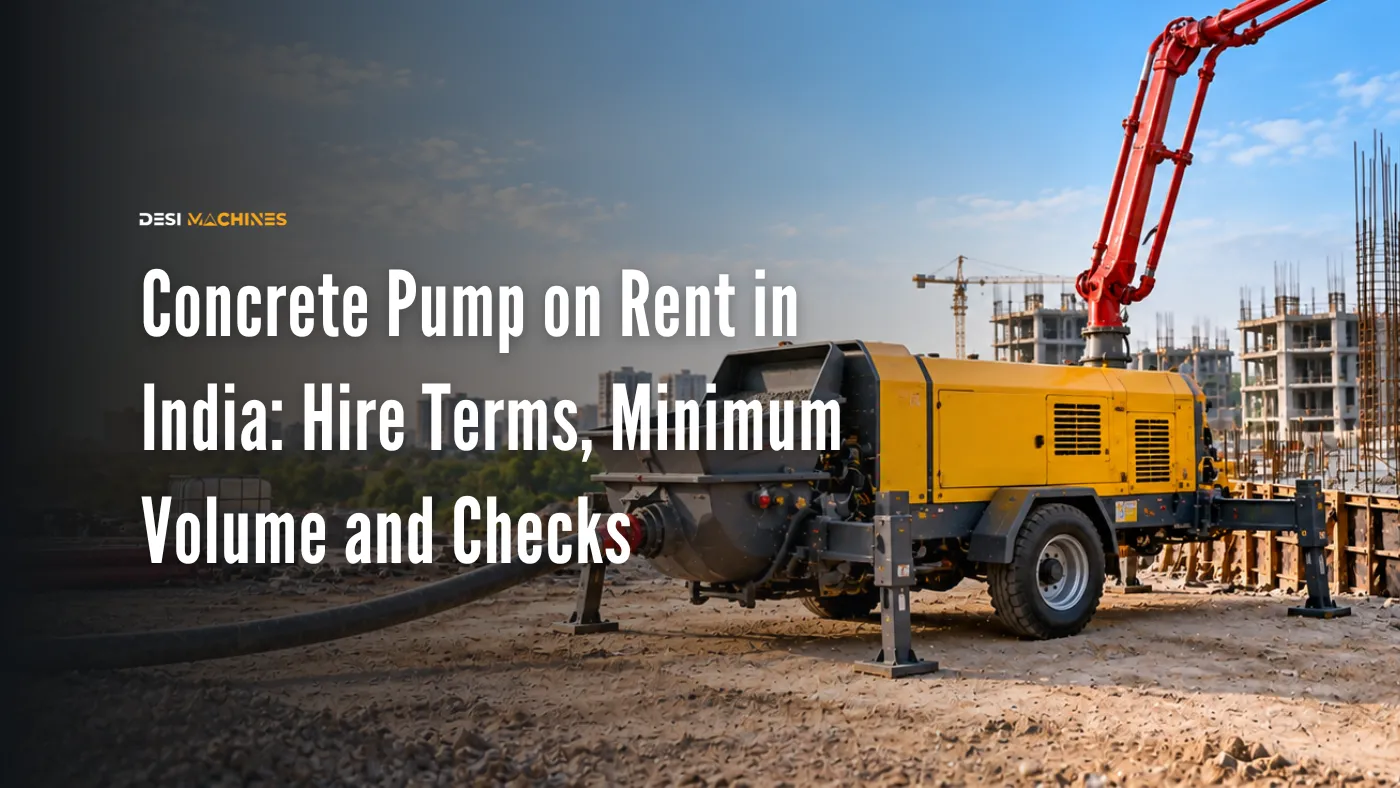
A concrete pump on rent is a machine hired for a single pour, which pushes fresh concrete through a steel pipeline from the point where the mixer unloads to the point where the concrete has to land. You are buying the pour, not the machine. On most Indian sites this is how pumping is arranged, because a pump earns nothing on the days you are not casting.
This guide covers which type of pump you actually hire, how pump hire is billed, what a minimum volume is and why it decides your bill, which output to ask for, and what to check before the first mixer arrives. What it does not do is quote a hire rate, and the reason is set out below.
What does it mean to take a concrete pump on rent?
It means the pump owner brings the machine to your site, pumps your concrete, and takes the machine away. Pump hire works differently from hiring a backhoe or a roller, and the difference catches first-time hirers out.
With most machines you choose between dry hire, where you get the machine alone and arrange your own operator and diesel, and wet hire, where the owner sends his man. A concrete pump is almost always wet hire. Nobody hands over a pump on its own, because a pump run badly blocks its line within minutes and the repair is the owner’s problem, not yours. So the operator, and usually a helper on the end hose, come with the machine.
The second difference is what you are paying for. A grader is hired by the day. A pump is normally priced against the volume of concrete it moves, measured in cubic metres, with a floor under it. That floor is the part that decides whether a small pour is worth pumping at all.
The general mechanics of hiring in India — the documents a yard asks for, the security deposit, how a billing period is counted — are the same for a pump as for anything else, and are set out in the guide on how to rent construction equipment in India.
Boom pump or line pump: which one are you hiring?
Ask this before you ask about the rate, because the two machines are hired for different reasons and quoted in different ways.
A boom pump is a pump built onto a truck with a folding arm carrying the pipeline. It parks, puts its legs down, and places concrete over a distance without anybody laying pipe. This is what a builder hires for a slab several floors up, or for a raft foundation a mixer cannot drive onto. The number that matters is the boom reach, the distance the arm covers when fully open, and it is the first thing a yard will ask you for. The arithmetic of reach against building height is worked through in the guide to the concrete pump truck and how far it reaches.
A line pump, also called a stationary pump, is a pump on a trailer or skids with no arm at all. Your team lays the pipeline by hand to wherever the concrete has to go. It is slower to set up and it needs labour to shift pipe, but it fits down a lane a truck cannot enter, and it costs less to hire.
The split that holds on most Indian jobs is simple: hire the boom, own the line pump. A boom pump truck is a large machine bought by pumping contractors and ready-mix suppliers who keep it busy every day. The 66 stationary and line pumps listed on DesiMachines are the machines a contractor buys for his own regular work — you can see the full range of stationary and line concrete pumps if the hiring is starting to add up. For what separates the types, the guide to boom, line and stationary concrete pumps covers the ground.
How much does a concrete pump cost to rent in India?
We do not publish a concrete pump hire rate, and we would rather say so than print a number we cannot stand behind. The equipment rental rate card carries indicative hire bands for backhoe loaders, excavators, wheel loaders, road rollers, hydra cranes and self-loading mixers, because those machines hire at rates a yard will repeat to any caller. Pumping is quoted job by job, because the price is built from your pour and not from the machine.
What you can control is what the quote is made of. Six things move a pumping number: the volume you are casting, the height or distance the concrete has to travel, how much pipeline has to be laid and by whom, how far the machine travels to reach you, whether the pour is at night or on a Sunday, and how busy the season is. Pumping gets scarce and dear through the dry casting months and after the monsoon breaks.
Fix these in writing before the machine moves:
- The billing basis. Per cubic metre pumped, a day rate, or a combination. Ask which, and ask what happens if the pour runs over.
- The minimum. Every pumping quote has one. It is covered in the next section and it is the single largest surprise on a small pour.
- Waiting time. Your pump will sit while mixers are stuck in traffic. Agree what a standing hour costs, because the default answer is that you pay for it.
- Pipeline, bends and clamps. Who supplies them, how much length is included, and what extra length costs.
- Mobilisation both ways. Bringing the machine and taking it back are separate charges, and the return leg is the one people forget. How this is normally split is set out in the guide to rental mobilisation and transport.
- Washout and disposal. A pump and its line have to be cleaned after every pour, and the slurry has to go somewhere on your site.
- The blockage clause. Who clears a choked line, who pays for the lost hours, and whose concrete it was. Agree it before the pour, never during one.
Get it on paper with the inclusions listed underneath. The clauses that protect both sides are set out in the guide to the equipment rental agreement, and if you are weighing hiring against owning across your whole fleet, the buy versus rent decision guide works through the sums.
What is the minimum volume on a concrete pump hire?
The minimum volume is the quantity of concrete you are billed for whether you pump it or not. If the minimum is set at a certain number of cubic metres and your slab takes less, you still pay for the full figure.
It exists because the pump owner’s cost is mostly in getting there. Loading the machine, driving it to your site, setting it up, cleaning it afterwards and driving home takes most of a day regardless of whether you cast a small landing or a full floor. The pumping itself is the quick part.
This has three practical consequences, and they are worth planning around:
- Work out your volume before you call. Length by width by thickness, in metres, gives you cubic metres. A slab 10 m long, 8 m wide and 125 mm thick is 10 m³. Add a little for wastage and for the pipeline the concrete sits in.
- Club your pours. If your columns and your slab are close together in the programme, casting them on one visit can put you over the minimum instead of paying it twice.
- Below a certain size, do not pump at all. For a small footing or a short lintel, a mixer and labour with wheelbarrows will beat a pumping minimum. Pumping earns its money on volume and on height, not on convenience.
Ask two questions of any yard: what is the minimum, and is it charged in cubic metres or as a flat visit charge. The answers are not the same thing, and yards use both.
How much concrete can a pump move in an hour?
Ask for an output figure in cubic metres per hour, and then plan on less than it. The rated figure on a spec sheet is a maximum theoretical output, which is what the machine would move if concrete arrived without a break and the line never had to be cleared. Real site output is lower, and the thing that usually limits it is not the pump — it is how fast the mixers reach you.
Across the 66 stationary and line pumps listed on DesiMachines, rated output runs from 27 to 116 m³/hr, and the middle of the range sits near 58 m³/hr as per the current September 2026 specifications. Fifty of those 66 publish two figures rather than one, because the machine can be run in a faster low-pressure mode or a slower high-pressure mode; the higher number is the fast mode. What each mode buys you is worked through in the guide to concrete pump output and pressure.
| Rated output | Machines in this band | What this size normally suits |
|---|---|---|
| Under 40 m³/hr | 15 | House slabs, small commercial floors, short pipeline runs |
| 40–59 m³/hr | 23 | The mainstream — apartment slabs and general contractor work |
| 60–79 m³/hr | 20 | Larger rafts, longer pipeline runs, tighter pour windows |
| 80 m³/hr and above | 8 | Continuous high-volume work, ready-mix and infrastructure pours |
Size the hire against your mixer supply, not against the biggest pump the yard has. A pump rated at 60 m³/hr fed by mixers delivering 20 m³ an hour is a pump standing idle on your bill. The arithmetic on the delivery side is worked through in the guide to transit mixer productivity, trips and cycle time.
What has to reach your site before the pump can work?
A pump that cannot get in, or cannot be fed once it is in, is the most expensive thing on a hire bill. Check four things before you book.
The machine itself has to physically arrive. A trailer-mounted line pump is towed in and needs a gate and a lane it can pass. The published envelope across the listed machines is set out below. Note how many machines publish each figure — dimensions are not filled in on every listing, so confirm the exact machine with the yard.
| Figure | Published range | Machines publishing it |
|---|---|---|
| Machine weight | 2,800–10,000 kg (2.8–10.0 tonnes) | 43 of 66 |
| Overall width | 1,600–2,908 mm (about 5.2–9.5 ft) | 30 of 66 |
| Overall height | 1,795–2,835 mm (about 5.9–9.3 ft) | 30 of 66 |
| Overall length | 4,500–7,408 mm (about 14.8–24.3 ft) | 26 of 66 |
The mixers have to reach the pump. The pump sits where a transit mixer can back up to its hopper and tip. That hopper holds between 400 and 625 litres on the 65 machines publishing the figure, which is a fraction of a mixer load, so the mixer feeds it steadily rather than emptying into it.
Power or fuel has to be there. Of the 66 pumps listed, 51 run on a diesel engine, 13 are electric and 2 do not state a drive type. An electric pump needs a connection with the capacity to run it, which on a site without a proper supply means a generator you have to arrange. Confirm which you are getting. The drive types and what each suits are covered in the explainer on concrete pump parts and components.
Water has to be there. Priming the line before the pour and washing out afterwards both need water, and the washout has to drain somewhere that is not your neighbour’s plot.
What should you check before the pour starts?
You will not get to inspect a pump the way you would inspect a machine you are hiring for a month. What you can do is spend ten minutes when it arrives, because once the concrete is moving nobody stops to argue.
- The pipeline and the clamps. Look at the wall thickness of the pipe and at every clamp and gasket. A worn clamp is what parts a line under pressure, and it parts at the joint nearest a person.
- The hopper and the grille. The grille over the hopper keeps oversized aggregate and stray steel out of the pump. If it is missing, refuse the pour until it is fitted.
- Hydraulic leaks. Look under the machine and around the cylinders. A pump that is dripping before it starts will drip harder under pressure.
- The concrete itself. More blocked lines are caused by the mix than by the machine — the wrong slump, a badly graded aggregate, or a load that has stood too long in traffic. The causes and the safe way to clear a choke are set out in the guide to concrete pump line blockage.
- Where people will stand. Agree the pipeline route, keep the line supported and clamped, and keep everybody clear of the end hose. A hose under pressure moves without warning.
Write a short note of the machine’s condition on arrival, get the owner’s operator to sign it, and photograph the pipeline. Almost every hire dispute in India is about damage neither side recorded at the start. If your machines and hired plant need cover, the guide to insurance for rented equipment explains whose policy actually pays.
Do you pay GST and TDS on concrete pump hire?
Yes to both, and the two work in opposite directions on the same bill. Hiring out equipment with an operator is a supply of service, so a pumping bill carries GST, and a registered contractor can normally take that tax as input credit. Insist on a proper tax invoice carrying the owner’s GSTIN — a hand-written slip is not a bill you can claim against.
Separately, a payment for machinery hire attracts tax deducted at source, so you deduct before you pay and deposit it against the owner’s account. Which rate applies depends on how the contract is written, and it is a common argument between hirer and owner. The rates and the distinction are set out in the guide to TDS on machinery hire charges. Confirm the treatment of your own contract with your accountant.
A pump is only half the hire on most pours, because the concrete still has to reach it. The guide to taking a transit mixer on rent covers how mixer hire is billed and how far your site can be from the batching plant before the load stops being worth placing.
Renting a concrete pump: the short version
- Pump hire is wet hire. The operator comes with the machine, because a pump run badly blocks its own line.
- Hire the boom pump for height and distance; own a line pump if you pump every week. Boom reach is the number a yard asks for first.
- Pumping is priced against volume, not against days. Work out your cubic metres before you call.
- The minimum is the real cost on a small pour. Ask what it is and whether it is charged in cubic metres or as a visit charge, and club your pours to get over it.
- Match the pump’s output to how fast your mixers arrive. A 60 m³/hr machine fed at 20 m³/hr is a machine standing on your bill.
- Get the billing basis, the minimum, waiting time, pipeline length, mobilisation both ways, washout and the blockage clause in writing before the machine moves.
When the hiring starts to add up, compare concrete pump models and specifications and talk to a dealer, or read the used concrete pump buying guide before you look at a second-hand machine. The equipment rental guide covers the same ground for every other class, including the self-loading concrete mixer on rent that batches on site instead of pumping, and the mini concrete pump if the machine you keep wanting is a small one of your own.
Prices, specifications and features are indicative, vary by variant, location and date, and should always be confirmed with the official OEM or authorised dealer before any purchase decision. DesiMachines is not liable for decisions taken on the basis of information that may have changed after publication.
Machines, tenders and news for this industry: Ready-Mix Concrete