Which machine is used for underground cable laying?
No single machine lays underground cable. The method picks the machine, and India’s code for power cables, IS 1255:1983, names four ways to open the ground: by hand, by mechanical excavation, by thrust boring and by trench ploughing. It adds that only the first two are possible in cities and towns, where other services are already buried.
So most cable and optical fibre (OFC) work in India is open trench work: dig, bed the cable in sand, cover it with tiles or bricks, backfill, restore the surface.
| Method |
Where it is used |
Machines that do it |
| Open trench |
Footpaths, road shoulders, colony lanes, factory and campus sites |
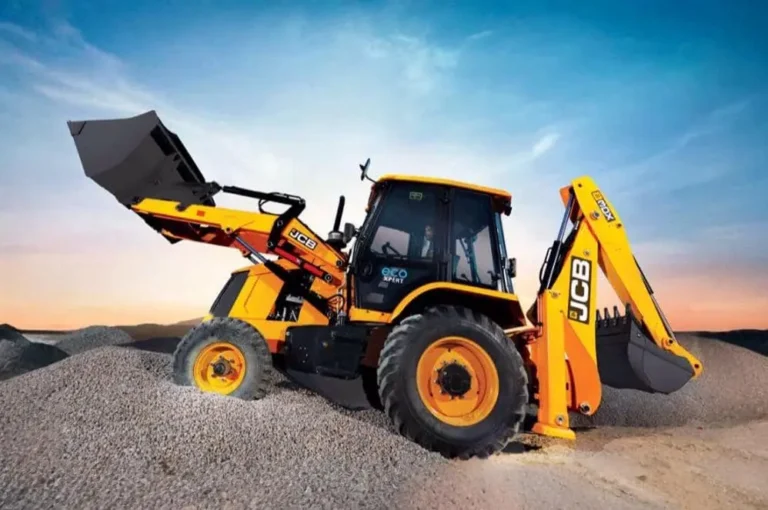
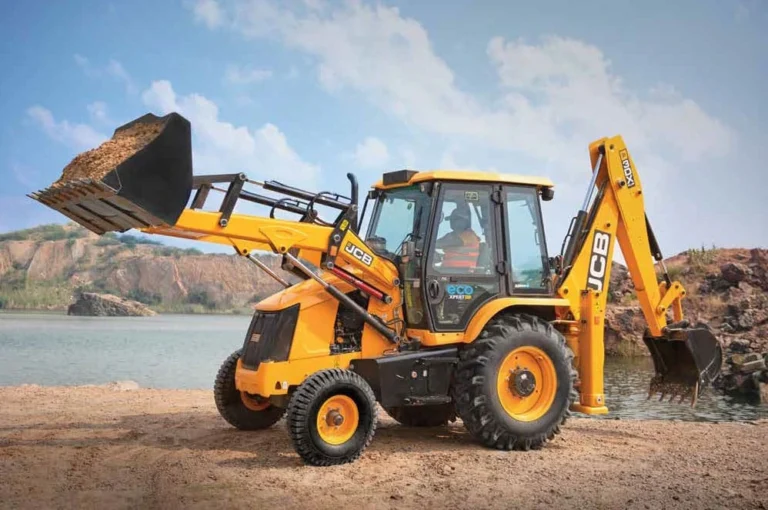
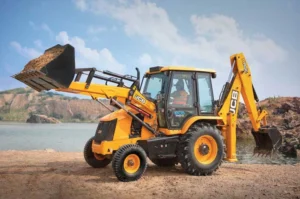
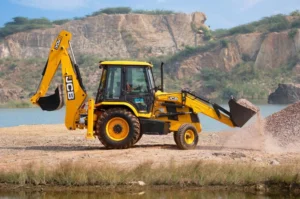
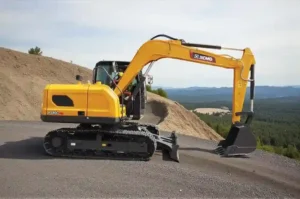
Mini and small excavators or backhoe loaders dig; skid steer loaders and backhoe loaders backfill; a tandem roller restores a road surface |
| Thrust bore or horizontal directional drilling (HDD) |
Under a road, rail line, canal or busy junction that cannot be opened |
HDD rigs push a bore under the obstacle and pull a duct back through it. Excavators dig the entry and exit pits. |
| Trench ploughing |
Open country with no other buried services nearby |
Cable ploughs and chain trenchers cut a narrow slot and lay the cable in one pass |
Depth is rarely the limit. IS 1255 puts the top of a power cable 0.75 to 1.05 metres down, well inside what the smallest machines reach, so width matters more (see digging depth by machine size). Backfill at the bottom of a narrow trench is firmed with an excavator compaction wheel.
HDD rigs, cable ploughs, chain trenchers and cable winches are not listed here.
Where is the most fibre being laid in India?
In a written reply to the Lok Sabha, the communications ministry gave the optical fibre laid in each state from April 2022 to March 2025, and each state’s total by December 2025 (Press Information Bureau, 11 February 2026). These eight laid the most:
| State |
Fibre laid, April 2022 to March 2025 |
Total fibre, December 2025 |
| Tamil Nadu |
1,02,865 route km |
3,08,907 route km |
| Kerala |
88,591 route km |
2,59,252 route km |
| Andhra Pradesh |
81,307 route km |
2,51,753 route km |
| Maharashtra |
70,178 route km |
4,06,637 route km |
| Telangana |
65,691 route km |
2,37,946 route km |
| Punjab |
60,654 route km |
1,97,105 route km |
| Uttar Pradesh |
55,672 route km |
4,06,697 route km |
| Rajasthan |
45,058 route km |
2,39,458 route km |
India laid 8,50,284 route km in those three years. The figures cover every telecom operator, BharatNet included, and do not split buried fibre from fibre on poles.
Who are the main cable and fibre laying companies in India?
The work comes from telecom operators, public sector network builders and cable makers with project arms. The list is alphabetical, not a ranking.
| Company |
What it builds or runs |
| Bharat Sanchar Nigam Limited (BSNL) |
The state-owned telecom operator, and one of the three public sector companies that built Phase-I of BharatNet, the rural fibre network |
| HFCL |
Makes optical fibre cables, including microduct and FTTH cables, and offers rural broadband solutions for BharatNet and railway communication systems |
| KEC International |
An EPC company whose businesses include power transmission and distribution, railways, civil works, oil and gas pipelines and cables |
| KEI Industries |
Makes extra high, medium and low voltage power cables and runs an EPC business |
| Polycab India |
Makes wires, cables and cable accessories and runs an EPC business |
| Power Grid Corporation of India |
A central public sector company, and the third of the three given BharatNet Phase-I, with BSNL and RailTel |
| RailTel Corporation of India |
A public sector company under the Ministry of Railways that lays optical fibre along railway tracks, using the railways’ right of way, and runs a fibre network across India |
| STL (Sterlite Technologies) |
Makes optical fibre and fibre cables and offers fibre roll-out services |
The three BharatNet Phase-I companies are named in the parliamentary standing committee’s report on BharatNet, as summarised by PRS Legislative Research; the other lines are from each company’s own website.

 Excavator
294 models
 Backhoe Loader
51 models
 Crane
68 models
 Concrete Mixer
79 models
 Wheel Loader
54 models
 Compactor / Roller
45 models
 Motor Grader
42 models
 Dozer
41 models
 Concrete Pump
66 models
 Skid Steer Loader
11 models
 Telehandler
13 models


 Most asked about
 ₹ 35-39 Lakhs
 ₹47.15 Lakh Onwards*







 New · Sep 2026₹43.75 Lakh Onwards*
 New · Jun 2026₹ 31 - 35 Lakhs