
 Excavator
294 models
Excavator
294 models  Backhoe Loader
51 models
Backhoe Loader
51 models  Crane
68 models
Crane
68 models  Concrete Mixer
79 models
Concrete Mixer
79 models  Wheel Loader
54 models
Wheel Loader
54 models  Compactor / Roller
45 models
Compactor / Roller
45 models  Motor Grader
42 models
Motor Grader
42 models  Dozer
41 models
Dozer
41 models  Concrete Pump
66 models
Concrete Pump
66 models  Skid Steer Loader
11 models
Skid Steer Loader
11 models  Telehandler
13 models
Telehandler
13 models 


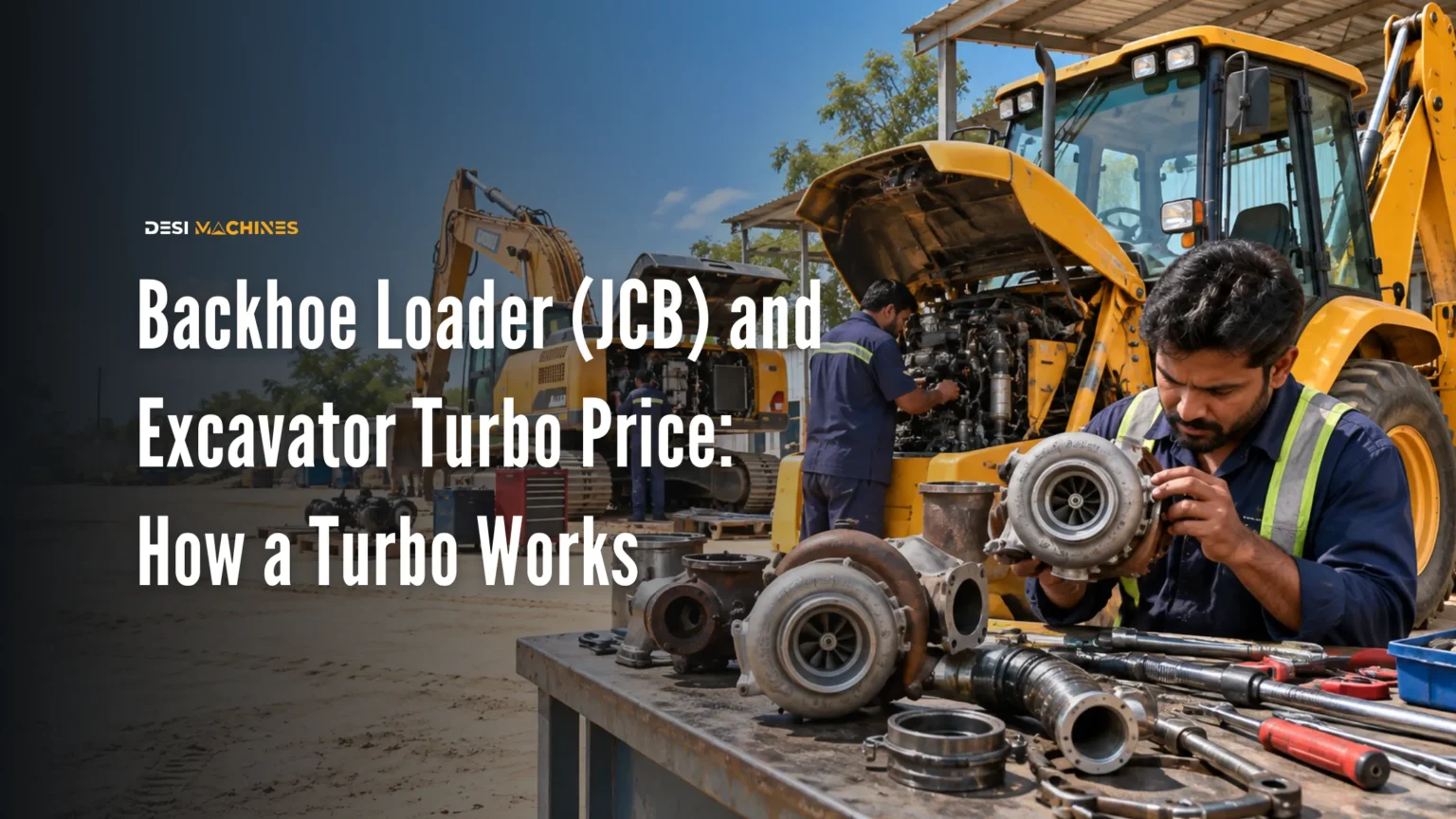
A backhoe loader that pulls well at low revs but goes weak, whistles or puffs blue smoke the moment it works hard usually has a turbo problem, and the JCB turbo price you will be quoted depends on which part of the turbo has failed: a hose, the actuator, the core or the whole unit. Before you pay for any of them, find out why it failed, because a turbo almost never dies on its own.
Most people in India say “JCB” when they mean any backhoe loader, and this guide uses the word the same way. It covers backhoe loaders and excavators of every make. It explains what a turbocharger does, how much difference it makes on a real machine, which machines carry one, the signs that it is failing, what kills turbos on Indian sites, and what moves the price before you ask a dealer for a quote.
What does a turbo do on a JCB or an excavator?
It pushes more air into the engine than the engine could suck in by itself. More air lets the engine burn more diesel cleanly, and that gives more pulling power from the same size of engine.
A turbocharger (turbo for short) is two small fan wheels on one shaft. The hot exhaust gas leaving the engine spins the first wheel, the turbine. The shaft turns the second wheel, the compressor, on the cold side, which draws in clean air from the air filter and squeezes it into the engine. Garrett, one of the largest turbo makers, explains in its guide to how a turbo works that the turbine can spin at up to 350,000 rpm, and that the squeezed air is usually passed through a charge-air cooler to make it denser before it enters the engine. That cooler is the intercooler, a small radiator for air.
An engine without a turbo is called naturally aspirated: it fills its cylinders by suction alone. It is simpler and has fewer parts to fail, but it makes less pull for its size.
How air and exhaust move through a turbocharged engine
- Air enters at the intake, often through a pre-cleaner on dusty machines.
- The air filter takes out dust. A torn filter lets grit straight into the compressor.
- The compressor wheel squeezes the air. It shares one shaft with the turbine.
- The intercooler cools the squeezed air so more of it fits in the cylinders. Not every engine has one.
- Diesel burns with the extra air in the cylinders.
- Hot exhaust spins the turbine wheel, which drives the compressor.
- The exhaust then leaves through the down pipe and silencer.
| Turbo part | What it does | How it usually fails |
|---|---|---|
| Turbine wheel and hot housing | Takes energy from the exhaust gas | Cracked housing from heat; wheel damaged by bits of broken engine part |
| Compressor wheel and cold housing | Draws in air and squeezes it | Blades chipped or worn by dust, stones or a loose filter part |
| Core (centre housing with shaft, bearings and seals) | Holds the shaft, which runs on a film of engine oil | Bearings wear when the oil is short, dirty or burnt; seals start passing oil |
| Wastegate and actuator | A valve that lets some exhaust bypass the turbine so boost does not go too high; the actuator opens and closes it | Actuator sticks, its rod seizes or its diaphragm splits; boost goes too low or too high |
| Oil feed pipe and oil drain pipe | Bring engine oil to the core and return it to the sump | Feed pipe blocked by carbon; drain hose kinked, so oil backs up past the seals |
| Intercooler, hoses and clamps | Carry and cool the squeezed air on its way to the engine | Split hose, loose clamp, intercooler packed with mud or leaking |
Two terms come up when you ask for a quote. The turbo core (also called the cartridge) is the centre section with the shaft, bearings and both wheels, without the outer housings. The turbo actuator is the can or electric motor on the side of the turbo that works the wastegate or, on some newer engines, a set of moving vanes inside the turbine housing.
How much difference does a turbo make?
On paper it can look like none, and that is the surprise. Two backhoe loaders listed on DesiMachines are each sold with the same engine block in a turbo and a non-turbo form, which makes them a fair test.
| Machine | Engine, as listed | Air intake | Gross power | Maximum torque |
|---|---|---|---|---|
| Mahindra Earthmaster SXE | Mahindra NEF3508, 3.5 litre | Naturally aspirated | 55 HP (41 kW) at 1,900 rpm | 217 Nm at 1,400 to 1,500 rpm |
| Mahindra Earthmaster SX | Mahindra NEF3508, 3.5 litre | Turbocharged, intercooled | 74 HP (55 kW) at 1,950 rpm | 400 Nm at 1,100 to 1,200 rpm |
| BEML BL9H 4×2 | Koel 4R1190NA1, 4.76 litre | Naturally aspirated | 74 HP (55 kW) at 2,200 rpm | 304 Nm at 1,500 rpm |
| BEML BL9H 4×4 | Koel 4R1190T-HT, 4.76 litre | Turbocharged | 74 HP (55 kW) at 2,200 rpm | 400 Nm at 1,200 rpm |
Look at the BEML pair. The horsepower is identical. The difference sits in the torque, which is the turning force of the engine, the pull you feel when the bucket bites into hard ground and the engine starts to labour. The turbo version makes about 32% more of it, and makes it 300 rpm lower down. On the Mahindra pair the turbo adds both: 19 more horsepower and about 84% more torque from the same 3.5 litre block.
So when a turbo goes weak, the machine does not stop. It feels like a non-turbo machine again: fine when travelling or lifting light loads, and bogging down when the bucket meets hard soil or the loader shovel goes into a heap. That slow fade is why owners often run a failing turbo for weeks without knowing. The backhoe loader engine power guide explains horsepower and torque in more detail.
A turbo also matters in the hills. It was first built to stop aircraft engines losing power in thin air, and it does the same job for a machine on a hill road in Himachal or Sikkim, packing the thin air back up before it reaches the cylinders.
Which backhoe loaders and excavators have a turbo?
Most full-size ones do. Of the 51 backhoe loaders listed on DesiMachines, 31 describe a turbocharged engine and 5 describe a naturally aspirated one. The five without a turbo are the Mahindra Earthmaster SXE, the Mahindra SX Smart 50, the BEML BL9H 4×2, the Manitou MBL 745 Ranger and the Tata Hitachi Shinrai Pro. The rest do not say either way in words. Every JCB listed with the JCB 430 CRDi Stage 5 engine, including the JCB 3DX and JCB 4DX, is listed as turbocharged with EGR (exhaust gas recirculation), and the CASE 770 NX as turbocharged and intercooled.
On excavators the turbo arrives with size.
| Excavator operating weight | Models listed | Listing describes a turbocharged engine |
|---|---|---|
| Under 6 tonnes (mini) | 50 | 0 |
| 6 to under 10 tonnes | 16 | 3 |
| 10 to under 20 tonnes | 35 | 12 |
| 20 to under 30 tonnes | 91 | 47 |
| 30 tonnes and above | 102 | 65 |
Not one of the 50 mini excavators describes a turbo, and the Kubota KX033-4 states outright that its engine is naturally aspirated. A mini excavator with a power complaint has its problem somewhere else.
The counts above undercount, because many listings give only the engine code. That code often carries the answer. Cummins names the plain engine 6B, the turbocharged one 6BT and the turbocharged, aftercooled one 6BTA, as set out in the Cummins B Series engine history. Thirty-nine excavators listed on DesiMachines run a Cummins 6BT-family engine, and 17 of those listings never use the word turbo, though the T in the code already says it. The same pattern shows on the Kirloskar engines in backhoe loaders: the codes ending in NA, such as 4R1190NA1, are described as naturally aspirated, and the codes with a T after the number, such as 4R1190T-HT and 4R1040T, are described as turbocharged.
| 20-tonne class excavator | Engine, as listed | What the listing says about the turbo |
|---|---|---|
| Tata Hitachi EX 210 Infra | Cummins 6BT5.9C | Not stated in words; the T in the code means turbocharged |
| Hyundai R210 Smart Plus | Cummins 6BT5.9-C | Not stated in words; the T in the code means turbocharged |
| JCB NXT 215 LC Fuel Master | Cummins 6BT 5.9C | Turbocharged |
| SANY SY220C-9XL Sparc+ | Cummins 6BTAA 5.9 | Turbocharged, with intercooler or aftercooler |
| Volvo EC215 | VECV E494 | Wastegate turbocharged, air-to-air intercooled |
| Komatsu PC210LC-10M0 SLF | Komatsu SAA6D107E-1 | Turbocharged, aftercooled |
This is a general guide based on machine size class. Always confirm the fit with your machine’s operator manual or the manufacturer before buying or fitting.
The engine brands guide shows who builds the engine in each make, which is the name you will need on the turbo order. For horsepower by excavator class, see excavator engine power by size.
What are the signs of a failing turbo?
Each fault shows itself in its own way, and the same symptom can come from a cheap hose or an expensive core. Check in this order before anyone opens the turbo.
| What you notice | What it usually points to | What to check first |
|---|---|---|
| Black smoke and weak pull under load, fine at idle | Not enough boost: split hose, loose clamp, leaking intercooler, sticking actuator or a worn turbo | Walk the air path from the turbo to the engine, joint by joint |
| Blue or grey smoke, oil level dropping between services | Oil getting past the turbo seals, often from a blocked oil drain or a choked air filter; worn engine rings give the same smoke | Take off the air hose at the turbo outlet and look for wet oil inside |
| A whistle or siren that rises with revs and is louder than before | Air escaping from a joint after the turbo, or bearings wearing so the wheel runs close to its housing | Listen at each hose joint at medium revs, keeping clear of the fan and belt |
| Grinding, scraping or a sudden loud howl | A wheel touching its housing, or blades breaking | Stop the engine at once; broken pieces can go into the engine |
| Oil on the outside of the turbo or in the intercooler pipes | A seal leak, or a loose oil feed or drain joint | Clean it off, run the engine and see where fresh oil appears |
| Warning light or reduced-power mode on a CEV electronic engine | The engine computer has seen boost outside its limits, from a leak, a sensor or the actuator | Have the fault code read with the dealer’s diagnostic tool |
There is one check any owner can do. With the engine off and fully cool, take the air hose off the turbo inlet and look at the compressor wheel. Spin it gently with a finger. It should turn freely and quietly. A tiny bit of movement in the shaft is normal on most turbos, because the bearings float on oil. Blades that are chipped or bent, any mark where the wheel has touched the housing, or a pool of oil inside are not normal.
Black smoke has more causes than the turbo, including the air filter and the injectors. The black smoke from exhaust guide walks through all of them, so rule those out before blaming the turbo.
Why do turbos fail on Indian sites?
Oil is the first reason. The shaft spins on a thin film of engine oil, and anything that thins, dirties or interrupts that film wears the bearings. Stretched oil changes, the wrong grade, a clogged oil filter or a low sump all show up in the turbo before the engine. The engine oil guide covers grades and change intervals by machine.
Hot shutdown is the second, and it is an everyday habit on Indian sites. An operator finishes an hour on the breaker, or a long run loading tippers, and switches straight off to go for lunch. The oil stops flowing at once, but the turbine is still very hot from the exhaust. The oil left inside the core bakes into hard carbon, which is called coking. A little coke every day slowly blocks the oil passages until the bearings run dry.
Dust is the third. Sites here are dry and dusty for much of the year. A torn air filter, a loose clamp on the intake or a cracked hose after the filter lets fine grit straight into the compressor, where it sandblasts the blades. Keep the filter element and every intake hose in good order; the excavator filters guide explains the air filter and its safety element.
Over-fuelling is the fourth. Turning the fuel pump up to make a machine feel stronger raises exhaust temperature, and the turbine housing and wheel take the heat first. It also makes black smoke, never cures it.
Revving a cold engine hard right after starting is the fifth. For the first few seconds the oil has not reached the core, and high revs on a dry bearing do damage fast.
The pattern is the point. Something outside the turbo kills it, and a new turbo fitted without fixing that cause fails the same way.
How do you make a turbo last longer?
Five habits cover most of it.
- After hard work, let the engine idle for a few minutes before switching off, so oil carries the heat out of the core. The operator manual gives the time for your engine.
- After a cold start, idle until the oil pressure light is out and the engine runs smoothly before asking for full power.
- Change engine oil and oil filter on time, with the grade the manual names. Short-cycle, dusty work may need the shorter interval.
- Clean or change the air filter on schedule and check every intake hose and clamp at each service.
- Never let anyone raise the fuel setting, and never ignore a turbo whistle or an oil leak around it.
These checks sit in the service schedule by hours. The intercooler usually sits in the same cooling pack as the radiator, so when you blow out the radiator and cooling pack, clean the intercooler fins too.
Thinking about whether a whole engine rebuild is worth it on an older machine? The engine overhaul cost article weighs repair against replacement, and the current backhoe loader range is there to compare against the quote.
What decides the price of a JCB turbo?
The figure you are quoted moves with six things.
- Which part has failed. A hose, clamp or gasket is a small part. An actuator costs more. The core costs more again, and a complete turbo with both housings is the biggest of these.
- The engine model and emission stage. Older BS-III engines are mechanically controlled. Newer CEV Stage IV and Stage V engines run electronic engine control, and where the turbo has an electric actuator it costs more and may need setting up with the dealer’s tool after fitting. The BS-CEV emission norms guide shows which stage your machine was built to.
- Engine size. A 3 to 5 litre backhoe loader engine takes a smaller turbo than the 5.9 litre and larger engines on 20-tonne and bigger excavators.
- What failed with it. If a wheel broke up, pieces may be sitting in the intercooler and pipes, and those need cleaning or replacing. The oil feed pipe, drain hose and gaskets are usually replaced with the turbo, along with an oil and filter change.
- Access and labour. On a backhoe loader the turbo is easy to reach. On a large excavator it may mean removing guards and pipes first.
- Fixing the cause. A blocked oil feed pipe or a torn air filter adds a little to the bill and saves the new turbo.
The backhoe loader parts guide and the excavator parts guide cover the other systems that wear on these machines, and the parts and running costs guides list every item in this series.
How do you order the right turbo for your machine?
Take four things to the dealer or parts seller: the model name, the machine serial number, the engine model from the engine plate, and the year of manufacture. Most turbos also carry their own label or plate with a part number on the housing. Photograph it before you remove anything, because one machine model can carry different turbos across its years and engine changes.
Order the gaskets, oil feed pipe seals and the drain hose together with the turbo. Before the new one goes on, change the engine oil and filter, check the air filter, and make sure the oil feed pipe is clear. After fitting, the fitter should fill the new turbo’s oil inlet with clean engine oil and crank the engine without starting it until oil pressure comes up, then idle it gently. Ask whether that was done.
The exhaust side starts right after the turbo. If the down pipe or silencer is cracked as well, the silencer and exhaust parts guide covers those.
This is a general guide based on machine size class. Always confirm the fit with your machine’s operator manual or the manufacturer before buying or fitting.
When repair bills start stacking up on an old machine, compare them with a newer one. Browse the backhoe loaders and excavators listed in India and speak to a dealer.
Where the figures in this guide come from
The machine counts and engine descriptions come from the specification sheets on the backhoe loader and excavator listings on this site, read in October 2026: 51 backhoe loaders and 294 excavators, grouped by the operating weight each listing gives. A model counts as turbocharged only where its engine description uses the word. The engine-code reading follows the Cummins naming linked above, and the Kirloskar pattern is the one the listings themselves show.
This guide gives no part prices, because turbo parts vary too much by engine, year and seller for a printed figure to stay true. A dealer quote against your serial number and engine plate is the only reliable price.
Prices, specifications and features are indicative, vary by variant, location and date, and should always be confirmed with the official OEM or authorised dealer before any purchase decision. DesiMachines is not liable for decisions taken on the basis of information that may have changed after publication.
Get a turbocharger price from a dealer near you
Tell us your machine and what you need, and we will ask the nearest dealer to reach out to you with a price.