
 Excavator
294 models
Excavator
294 models  Backhoe Loader
51 models
Backhoe Loader
51 models  Crane
68 models
Crane
68 models  Concrete Mixer
79 models
Concrete Mixer
79 models  Wheel Loader
54 models
Wheel Loader
54 models  Compactor / Roller
45 models
Compactor / Roller
45 models  Motor Grader
42 models
Motor Grader
42 models  Dozer
41 models
Dozer
41 models  Concrete Pump
66 models
Concrete Pump
66 models  Skid Steer Loader
11 models
Skid Steer Loader
11 models  Telehandler
13 models
Telehandler
13 models 


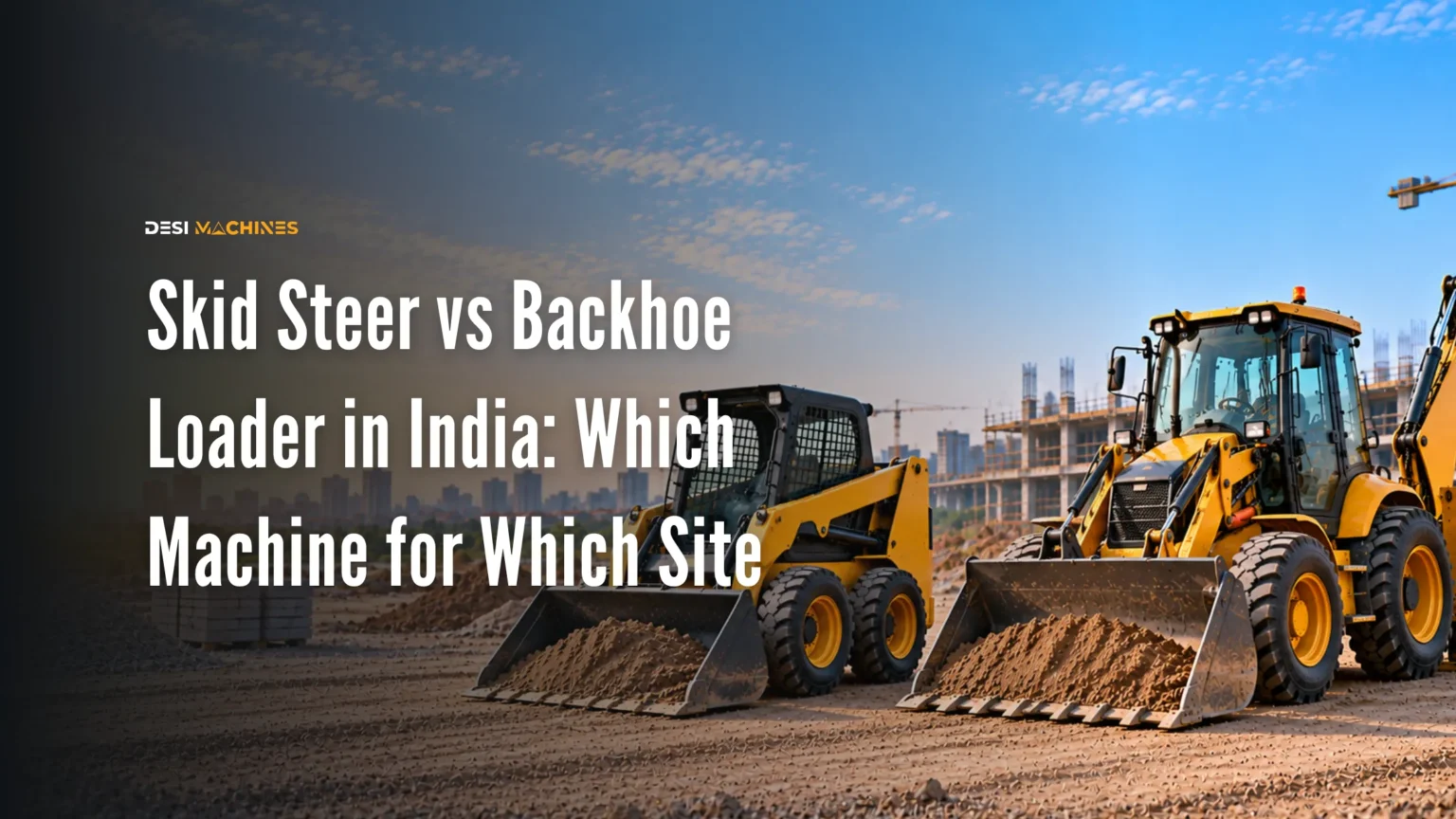
A skid steer loader is a small four-wheeled loader that steers by dragging the wheels on one side, and a backhoe loader is a tractor-based machine with a loading bucket at the front and a digging arm at the back. In the skid steer vs backhoe decision the deciding fact is digging: all 51 backhoe loaders listed on DesiMachines publish a maximum digging depth, and none of the 11 skid steer loaders publishes one at all, because a skid steer has no rear digging arm.
That single difference settles most Indian buying decisions. If the work involves trenching, foundations, pipeline or drain work, you need the backhoe. If the work is loading, cleaning, feeding and handling in a space too tight for a backhoe to swing, the skid steer earns its place. Everything below is measured from the machines actually sold here, so you can see how far apart the two really are.
What is the difference between a skid steer and a backhoe loader?
The difference is the back half of the machine. A backhoe loader carries two tools on one chassis: a front shovel for loading and a rear boom, arm and bucket for digging. A skid steer carries one tool position, the front loader arms, and everything else is an attachment you buy separately and hang off those arms.
The names people use on site follow the same split. A backhoe loader is what most contractors simply call a JCB, after the brand that made it common in India, and the trade also calls it a TLB (tractor-loader-backhoe). A skid steer is often called a Bobcat for the same reason, after the brand that introduced the type.
Steering is the second real difference, and it is where the skid steer gets its name. It has no steering wheel and the wheels do not turn. The operator drives the left and right wheels at different speeds, so the machine pivots by letting the tyres skid across the ground. That is what lets it turn inside its own length. The mechanism, the controls and the wheels-versus-tracks question are covered in how skid steer loaders work.
A backhoe steers like a tractor, with a steering wheel and front wheels that turn. It needs room to manoeuvre, and it needs room behind it to set the stabiliser legs down before the digging arm can be used.
Can a skid steer dig like a backhoe?
Not as standard. Digging depth is a published specification on every backhoe loader and on no skid steer, and that is not an accident of the paperwork. It is because the digging arm is standard equipment on one machine and absent on the other.
Across all 51 backhoe loaders, maximum digging depth runs from 3,020 mm on the JCB 2DX, the smallest machine in the class, to 5,360 mm on the JCB 4DX. In plain terms, the smallest backhoe sold here digs a little over three metres down and the deepest digs over five metres, which is enough for a house foundation, a sewer line or a borewell approach trench without any second machine on site. Depth, reach and dump height for the class are set out in backhoe loader bucket capacity, dig depth and dump height.
On the skid steer side the figures are tighter than most buyers expect: skid steer dump height and reach sets out dump height, dump reach and dump angle for all eleven machines, and shows that the whole class dumps lower than the small wheel loader class.
A skid steer can be made to dig, but only by buying a backhoe attachment that bolts onto the loader arms, and it is a compromise. The attachment is smaller, it digs shallower, it has to be fitted and removed, and the machine has no stabiliser legs designed around it. For occasional light trenching in soft ground that is workable. For digging as the main job it is the wrong purchase. What a skid steer is genuinely good at with attachments (breaking, sweeping, augering, grabbing, levelling) is covered in the guide to skid steer attachments.
How big and how powerful is each machine?
The backhoe is roughly twice the machine by weight, but the two classes overlap on engine power more than most buyers expect. The table below compares the two classes as they are actually listed, using the full range from the smallest machine to the largest in each.
Table 1: Skid steer loader vs backhoe loader, class ranges from the machines listed on DesiMachines (September 2026)
| What you are comparing | Skid steer loader (11 machines) | Backhoe loader (51 machines) |
|---|---|---|
| Operating weight | 1,291 to 4,225 kg (1.3 to 4.2 tonne) | 5,220 to 9,700 kg (5.2 to 9.7 tonne) |
| Engine power | 23.5 to 93.3 HP (17.5 to 69.7 kW) | 49 to 100 HP (36.4 to 74.5 kW) |
| Front bucket capacity | 0.23 to 0.63 m³ | 0.60 to 1.26 m³ |
| Rear digging arm | Not fitted as standard | Maximum digging depth 3,020 to 5,360 mm |
| Width | 900 to 1,832 mm over the tyres | 1,912 to 2,800 mm over the bucket |
| Dump height | 1,882 to 2,675 mm | 2,300 to 3,000 mm |
| Top speed | 9.8 to 14 km/h as standard | 28 to 40 km/h in top gear |
| Indicative price | ₹13–32 Lakh | ₹22–40 Lakh |
Two notes on how to read that table. Backhoe width is published by 46 of the 51 machines and top-gear speed by 42 of them, with one further machine publishing a single maximum forward speed of 36 km/h, so those two rows describe most of the class rather than all of it. On the skid steer side, the speed figure is the standard range: two machines, the Bobcat S590 and the Bobcat S770, are two-speed and run to 18.4 and 19.8 km/h in high range.
Weight is where the classes genuinely separate. Only one backhoe sits below six tonnes (the JCB 2DX at 5,220 kg) and only one above nine (the Bull Grandia at 9,700 kg); the other 49 sit between seven and nine tonnes. Ten of the 11 skid steers weigh between 1,291 and 3,275 kg, with one heavier machine at 4,225 kg. The backhoe weight class, and how operating weight differs from gross weight, is explained in excavator and backhoe weight in India, and the backhoe engine range in backhoe loader engine power.
The power overlap is worth understanding rather than ignoring. A large skid steer at 93 HP has more engine than a small backhoe at 49 HP. That does not make it the more capable machine on a mixed site, because the backhoe converts its power into digging and reach while the skid steer converts it into hydraulic flow for attachments. Power tells you what the machine can drive; the tools bolted to it tell you what it can do.
How much can each one lift and carry?
The two classes are measured differently, so a straight number-to-number comparison misleads. A skid steer publishes a rated operating capacity — the safe working load, set at half the weight that would tip the machine forward. A backhoe publishes a maximum payload for the front shovel instead.
Rated operating capacity across the 11 skid steers runs from 318 kg to 1,520 kg, with eight of the 11 between 600 and 760 kg. Maximum payload on the backhoes that publish it runs from 800 kg to 2,400 kg. Read together, a mid-size skid steer carries a few hundred kilos per pass, while a backhoe shovel carries two to three times as much. The full skid steer figures, model by model, including tipping loads, sit in the skid steer loader specifications and models guide.
Bucket volume tells the same story. The two classes very nearly touch at the join. The largest skid steer bucket listed here is 0.63 m³ and the smallest standard backhoe shovel is 0.60 m³, but that smallest shovel belongs to one machine. The common backhoe shovel is 1.1 m³, fitted to 30 of the 51, which is roughly double what a typical skid steer bucket holds. If you are loading tippers all day, that difference decides how many machine-hours the job takes. Loading and trenching output for the backhoe class is worked through in backhoe loader productivity in India.
Which machine fits a narrow site?
The skid steer, and this is its strongest argument. Measured over the tyres it is 900 to 1,832 mm wide, while a backhoe measured over the front bucket is 1,912 to 2,800 mm. The narrowest skid steer sold here is under a metre wide and will pass through a standard gate, a compound wall opening or a cattle shed door that no backhoe can enter.
Turning is the other half of it. Because a skid steer pivots on the spot, it needs almost no swing room, whereas a backhoe needs space in front to turn and space behind to plant its stabiliser legs. On a demolition floor, inside a warehouse, in a poultry or dairy shed, in a lane in an old town centre, or on a plot where the neighbour’s wall is a metre from the work, the backhoe simply cannot be positioned. That is the situation where a skid steer stops being a luxury.
Height matters in the same way. Every one of the 11 skid steers stands between 1,814 mm and 2,110 mm to the top of the cab, under 2.2 m on all of them, so the machine goes under a shed roof, a low beam or a doorway a backhoe would foul. Farm and shed work, where these dimensions decide everything, is covered in skid steer loaders for agriculture in India.
Which one can drive itself between sites?
The backhoe, comfortably. Backhoe loaders run 28 to 40 km/h in top gear, which is road speed, and they are built and registered to drive on public roads between jobs. That is a real running-cost advantage in India, where a contractor may work three sites in a week within the same district.
A skid steer tops out at 9.8 to 14 km/h in standard form. It is a yard machine. Moving it to the next site means a trailer, a tractor or truck to pull it, and a person to load and unload it. Budget that cost honestly before buying, because it is charged on every move and it does not appear on any spec sheet.
This is the single reason the backhoe remains the default machine for the Indian contractor who works across scattered sites, and the skid steer tends to be bought by owners who keep it in one place: a plant, a yard, a farm, a warehouse, a single long project.
What does a skid steer and a backhoe cost in India?
A skid steer loader costs roughly ₹13–32 Lakh and a backhoe loader roughly ₹22–40 Lakh (both indicative, as of September 2026). The skid steer range covers all 11 machines listed. The backhoe range is taken from the 45 of 51 machines that publish a full price band; three are shown as price available soon and three quote an open-ended starting figure, so none of those six sets either end of the range.
The ranges overlap, which surprises buyers who assume the smaller machine is always the cheaper one. A well-equipped large skid steer costs more than an entry-level backhoe. So price alone will not choose for you. The capability difference will.
Two costs sit outside the sticker price and both favour the backhoe in Indian conditions. The first is transport, as above. The second is resale: the backhoe has a deep, liquid second-hand market in every district, while skid steer demand is thinner and concentrated in cities and industrial belts, so a used skid steer can take longer to sell. If you are funding the purchase, the lender panel and how equipment loans are structured here are set out on the equipment finance page.
For both machines, the on-road cost adds transportation, RTO registration, TCS, insurance and warranty where applicable, since both are wheeled machines that get registered.
Compare live skid steer loader models and prices or browse the full range of backhoe loaders and talk to a dealer.
Which machine should you buy for your site?
Answer three questions in order, and the machine picks itself.
Does the job involve digging? If trenching, foundations, drainage, pipeline or cable work is even a quarter of your work, buy the backhoe. A skid steer with a bolt-on backhoe attachment is a compromise you will regret on the first hard-soil job.
Can a 2.4-metre-wide machine physically reach the work? If the answer is no (a gate, a wall, an internal floor, a shed, a congested lane) then the backhoe is not an option however much you want its digging arm, and the skid steer is the machine that can actually get there.
Do you move between sites? If yes, the backhoe drives itself and the skid steer needs a trailer every time. If the machine will live in one yard, that stops mattering.
For most first-time buyers in India the answer comes out as the backhoe, and that is not brand loyalty — it is the only machine of the two that digs, loads and drives to the next job on its own. The skid steer is a deliberate second choice, bought for tight access, for attachment-heavy work, or as a second machine alongside a backhoe once the fleet grows.
If you are weighing a third option, the same comparison for lifting and material handling is in telehandler vs backhoe loader, and the loading-focused three-way choice between a wheel loader, a backhoe and a skid steer is discussed in the payloader and wheel loader guide.
If your work does not fit neatly into either machine, the machine finder asks about your job and site and names the machine that suits it.
Skid steer vs backhoe loader: the short version
The backhoe loader digs, loads and drives on the road. It weighs 5.2 to 9.7 tonnes, runs 49 to 100 HP, digs 3.0 to 5.4 metres down, carries a 0.6 to 1.26 m³ shovel and costs about ₹22–40 Lakh (indicative, as of September 2026). It is the default machine for Indian contractors and it is the right default.
The skid steer loader does not dig as standard, but it is 900 to 1,832 mm wide, turns inside its own length, weighs 1.3 to 4.2 tonnes, runs 23.5 to 93.3 HP and costs about ₹13–32 Lakh (indicative, as of September 2026). Buy it when access, not digging, is the thing standing between you and the work.
Before you commit to either, check the running side of ownership: skid steer fuel tank and oil capacities, backhoe loader oil and fluid capacities, and the backhoe parts that wear first.
All specifications and price ranges above are taken from the machines listed on DesiMachines at the time of writing (September 2026), and describe the class rather than any single machine. Prices, specifications and features are indicative, vary by variant, location and date, and should always be confirmed with the official OEM or authorised dealer before any purchase decision. DesiMachines is not liable for decisions taken on the basis of information that may have changed after publication.
Machines, tenders and news for this industry: Building Construction · Municipal and Waste
