Excavator
294 models
Excavator
294 models  Backhoe Loader
51 models
Backhoe Loader
51 models  Crane
68 models
Crane
68 models  Concrete Mixer
79 models
Concrete Mixer
79 models  Wheel Loader
54 models
Wheel Loader
54 models  Compactor / Roller
45 models
Compactor / Roller
45 models  Motor Grader
42 models
Motor Grader
42 models  Dozer
41 models
Dozer
41 models  Concrete Pump
66 models
Concrete Pump
66 models  Skid Steer Loader
11 models
Skid Steer Loader
11 models  Telehandler
13 models
Telehandler
13 models 


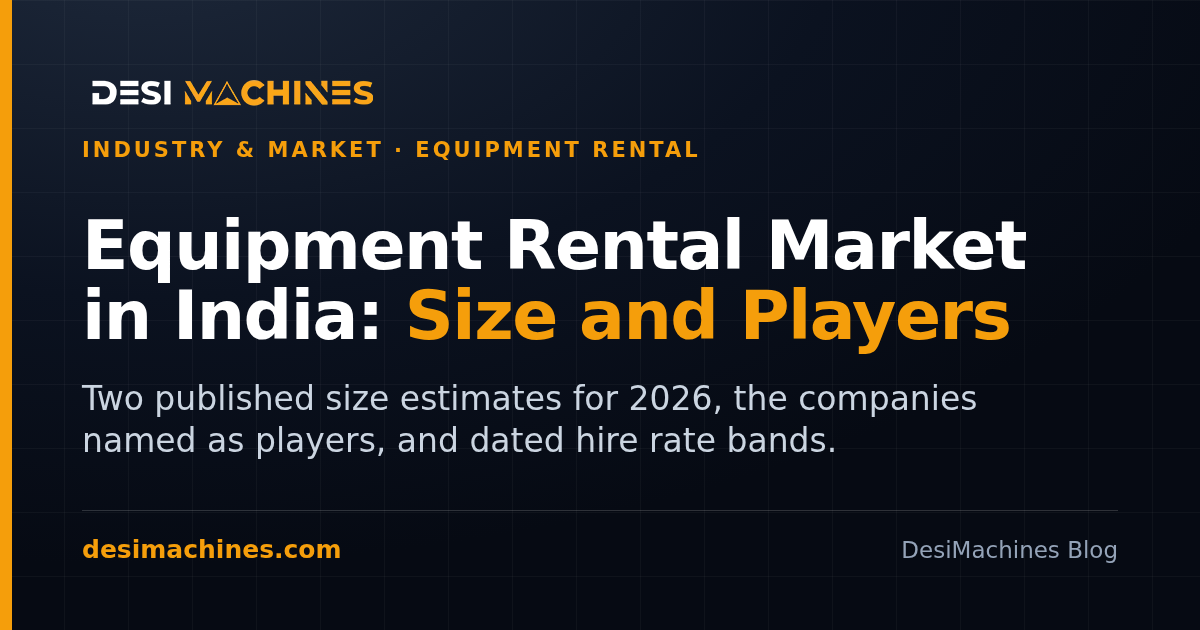
As of October 2026 there is no agreed construction equipment rental market size in India. Mordor Intelligence estimates USD 14.31 billion for 2026 on its report page read this month; MarkNtel Advisors, publishing in December 2025, values the same market at USD 4.67 billion for 2025. Both are honestly reported and they count different things. Below: what each figure measures, the companies the published reports name, dated hire rate bands for the common machines, and what the 2026 sales slowdown is doing to hire demand.
What is the construction equipment rental market size in India?
Two firms publish an India-specific number and they are nearly three times apart. That is not a forecasting disagreement, because they share a base year.
| Source | Published | Base-year size | Forecast | Growth rate |
|---|---|---|---|---|
| Mordor Intelligence | Report page read October 2026 | USD 13.62 bn (2025); USD 14.31 bn estimated for 2026 | USD 18.33 bn by 2031 | 5.07% CAGR, 2026 to 2031 |
| MarkNtel Advisors | December 2025, report code BM83383 | USD 4.67 bn (2025) | USD 8.98 bn by 2032 | 9.79% CAGR, 2026 to 2032 |
A base year is the year a report measures from before it starts forecasting. When two firms share one and still land this far apart, the difference is in scope: what each decided to put inside the word rental, and whether the figure counts hire revenue, the value of machines working on hire, or something between the two. Neither firm hides this. Both publish their segmentation, and the segments are not the same.
The practical reading for an owner is narrow. A market-size number is only usable next to its definition, and most places that quote these figures drop the definition first. If you are writing a loan application or a project report, quote the source, the base year and the scope line, not just the number.
What the segment splits say
The segment shares are more useful than the headline, because they describe the shape of the demand rather than its size.
Mordor Intelligence’s 2025 splits, from the report page read in October 2026: earth-moving equipment 63.02% of the market, internal-combustion machines 86.55%, short-term contracts 72.88%, and infrastructure as the end-user at 54.02%. It projects mining and quarrying as the fastest-growing end use at a 5.16% CAGR to 2031, and electric and hybrid machines at 5.18%.
MarkNtel Advisors’ December 2025 splits, for the same 2025: earthmoving equipment about 70% by type, road construction about 38% by application and growing at about 11% a year to 2032, and material handling the fastest-moving type at about 13% a year. It also publishes a regional split, with North India above 37% of the market and Uttar Pradesh alone at 16%.
Read together, three things are consistent across both reports despite the headline gap. Earthmoving is the majority of hired equipment. Short-duration hire dominates. And road and infrastructure work, not building construction, is the demand engine. That matches what the road roller hire and backhoe loader hire enquiries we see actually look like.
Who the players are
Nobody publishes an audited ranking of Indian rental companies by fleet size or revenue, and a self-made ranking would be a guess dressed up as data. So what follows is the published lists, with the source and date attached, in the order the sources print them. This is not a ranking.
Mordor Intelligence’s report page, read October 2026, names five as industry leaders with an explicit disclaimer that they are sorted in no particular order: Volvo Construction Equipment, Sanghvi Movers Limited, MYCRANE, Jindal Infrastructure and ABC Infra Equipment. Its wider company coverage for the same report adds ACE Cranes, All India Crane Hiring, Bull Machines Rentals, CASE India, Essar Equipment Bank, Gmmco Rental, Gulf Oil Rental Solutions, Indiabulls Store One Rentals, Jainex Group, JCB India, Kobelco India, L&T Rentals, Mtandt Rentals, Quippo Construction Equipment, Schwing Stetter India Rentals, Srei Equipment Finance and Tata Hitachi Construction Machinery.
MarkNtel Advisors’ December 2025 report names a partly different set: ABC Infra Equipment, All India Crane Hiring, Allcargo Movers, Dozex Earthmovers, Equiphunt, Jainex Group, Kasturi Earthmovers, Sanghvi Movers Limited, United Crane Services and VMS Equipment.
Only three names appear on both lists, which tells you something about the market. It is fragmented enough that two research firms looking at the same country in the same year pick largely different companies as representative. Mordor describes the market concentration as low in its October 2026 snapshot.
Note what the combined list is actually made of. Some are machine makers running captive hire arms, some are crane and heavy-lift specialists, some are finance companies that ended up with fleets, and some are regional earthmoving contractors who also hire out. “Rental company” covers four different businesses, and the kind you are dealing with changes the contract you will be offered. The ownership layers are set out in our guide to how construction and mining fleets are organised.
How much of the market is hired rather than owned
Two different percentages get quoted here, and they answer different questions.
The first is the share of new machines bought by rental companies instead of by the contractor who will use them. Off-Highway Research recorded that share rising from 47% in 2010 to 67% across 2020 and 2021, and in 2021 valued rental buyers at USD 2.3 billion of a USD 4 billion machine market, which is 58% measured in money. Rental takes more of the machines than of the spend because hire fleets buy proportionally more of the cheaper classes. These remain the most recent published figures on that measure, and they are five years old now, which is worth saying out loud.
The second is rental penetration of construction equipment use overall, which Mordor Intelligence’s 2026 report describes as a little under one-tenth and well below global norms. That is a much smaller number than 67% and it is not a contradiction: one counts purchases through the hire channel, the other counts how much equipment work is done on hire.
For a machine owner neither figure settles anything. What decides whether a machine on hire pays is utilisation, the share of working days it is actually earning. Buying against renting as an owner’s decision works through that arithmetic properly.
What hire rates look like in 2026
Rates are set locally, by who has a free machine this week and how far it has to travel, so no national rate list exists for any class. The bands below are indicative figures from our own rental pages, with the month each was current, and they should be read as a starting point for a negotiation rather than a quotation.
| Machine | Hire basis | Indicative band | As of |
|---|---|---|---|
| Backhoe loader | Per hour, dry hire | Rs 550 to 900 | July 2026 |
| Backhoe loader | Eight-hour day | Rs 5,000 to 9,000 | July 2026 |
| Backhoe loader | Full month | Rs 90,000 to 1,40,000 | July 2026 |
| Wheel loader, 17 to 18 tonne class | Per hour, wet hire | Rs 1,000 to 1,600 | July 2026 |
| Excavator, 20 tonne class | Per hour, wet hire | Rs 1,400 to 2,200 | July 2026 |
| Road roller | Per hour | Rs 800 to 1,500 | August 2026 |
| Road roller | Eight-hour day | Rs 15,000 to 25,000 | August 2026 |
Two things to hold in mind when you compare a quote against these. An operator on an otherwise dry backhoe hire adds roughly Rs 300 to 400 an hour on the same July 2026 basis, which is most of the gap between dry and wet rates. And mobilisation, the cost of getting the machine to site on a trailer and back, is a fixed cost on top that can dominate a short hire regardless of the hourly rate. Our equipment rental rate card covers the machine-by-machine detail and wheel loader hire rates and checks the payloader side.
The trends moving the market in 2026
Five things are visibly shaping Indian equipment hire this year.
Machine sales fell while hire forecasts rose. FADA retail registration data put construction equipment sales at 74,029 units in CY2025, down 6.67% from 79,316 in CY2024, with the brand-by-brand CY2025 breakdown here. ICEMA then reported Q3 FY26 total sales down 9% to 35,937 units, with domestic sales down 13% and exports up 16%, covered in our Q3 FY26 sales update. For hire fleets that softness cuts both ways: machines get cheaper to buy, and contractors who postpone buying hire instead.
Emission compliance is raising the price of entry. Mordor’s 2026 analysis notes that emission-compliant machines are priced more than a tenth higher and that the increase strains smaller balance sheets, which pushes work towards those who can still fund new machines. The Indian norms themselves are set out in our guide to BS-CEV emission norms.
Equipment makers are building their own hire arms. Several names on the published player lists are OEMs or their dealers rather than independent rental firms, and Mordor’s 2026 report cites JCB’s tie-up with Shriram Automall as a route for refurbished machines into short-tenor leases. That matters to a small owner because an OEM-backed fleet competes on service and finance, not only on rate.
Hire is still overwhelmingly short-term and diesel. Short contracts under six months took 72.88% of the 2025 market and internal-combustion machines 86.55%, both on Mordor’s figures. Electric is the faster-growing segment on a very small base, so expect it on urban and indoor work first.
Digital listing is compressing search, not rates. Online platforms make it easier to find an idle machine in the next district, which widens a hirer’s options. It does not create demand, and in a fragmented market it mostly moves work between owners.
What this means if you own machines or hire them
If you hire machines in, the market reports should change nothing about how you negotiate. Ask for the rate basis, the guaranteed minimum hours, who carries fuel and transport, and what happens on the day the machine breaks down. The published size of the market has no bearing on any of those.
If you own machines and hire them out, the useful signal in this data is where the competition sits. Two thirds of new machines going to hire buyers means the hire market is mature rather than empty, and a low concentration means your competitors are small and local, not national. That combination rewards the unglamorous things: a machine that starts every morning, an operator who stays, a rate you can hold, and customers who call back.
Either way, the number that decides whether a machine pays is your own utilisation, not the market’s CAGR. A market growing at 9% a year will not rescue a machine that works twelve days a month.
The bottom line
India’s construction equipment rental market has no single credible size figure as of October 2026, two published estimates nearly three times apart, a fragmented player base that two research firms describe with largely different company lists, and hire rates that are set district by district. What is consistent is the shape: earthmoving machines, short hires, infrastructure and road work, and a long tail of small owners.
For how the hire business actually works, from wet and dry hire to what a hire contract must cover, read our guide to the construction equipment rental market in India. If you are weighing up buying a machine to put on hire, compare live backhoe loader models and prices and excavator models and prices, starting with the class most Indian hire fleets are built on, the JCB 3DX, and check funding options on the equipment finance page.
Market size, share, growth and player figures on this page are quoted from the named third-party reports and dates shown beside them and are not DesiMachines estimates. Hire rate bands are indicative, vary by location, duration and machine condition, and were current in the month stated. Rates, schemes, specifications and prices change — confirm current terms with the OEM, dealer, bank or insurer before deciding.