
 Excavator
294 models
Excavator
294 models  Backhoe Loader
51 models
Backhoe Loader
51 models  Crane
68 models
Crane
68 models  Concrete Mixer
79 models
Concrete Mixer
79 models  Wheel Loader
54 models
Wheel Loader
54 models  Compactor / Roller
45 models
Compactor / Roller
45 models  Motor Grader
42 models
Motor Grader
42 models  Dozer
41 models
Dozer
41 models  Concrete Pump
66 models
Concrete Pump
66 models  Skid Steer Loader
11 models
Skid Steer Loader
11 models  Telehandler
13 models
Telehandler
13 models 


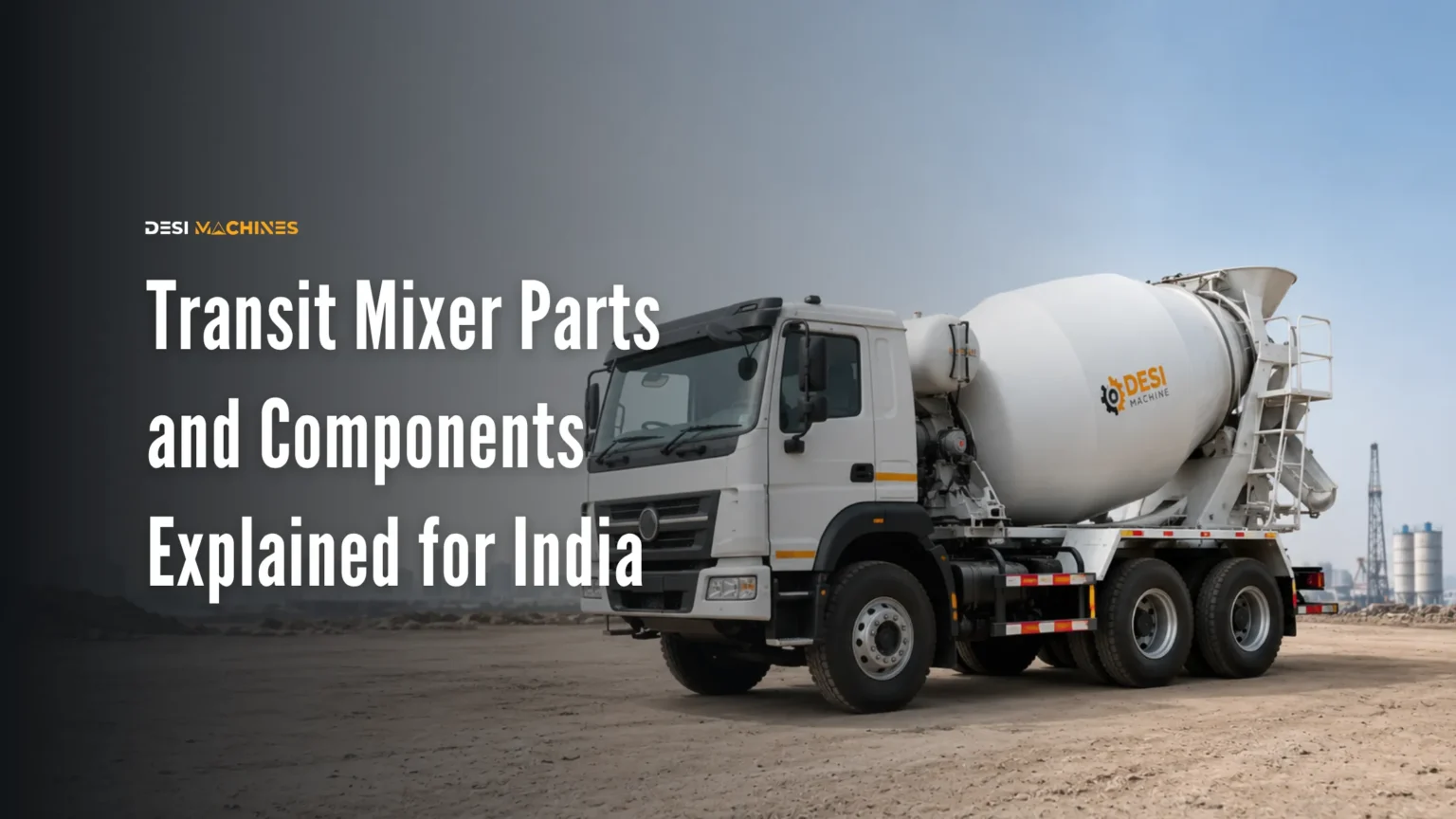
A transit mixer is two machines joined together, and its parts split the same way. On top sits the mixer unit: the drum, the spiral blades inside it, the rollers the drum turns on, the sub-frame it is mounted to, the water system and the drive that spins it. Underneath sits a truck chassis with its own engine, gearbox, clutch, axles, suspension, brakes and frame. So transit mixer parts come in two lists, not one. Learn which half a part belongs to and the machine becomes easy to read, because a fault on one half is a different repair, a different bill and often a different service network from a fault on the other.
Every figure below is taken from our listings at the time of writing, drawn from the 41 transit mixers currently listed for India (31 mixer units and 10 complete truck-mounted machines).
Parts of a transit mixer
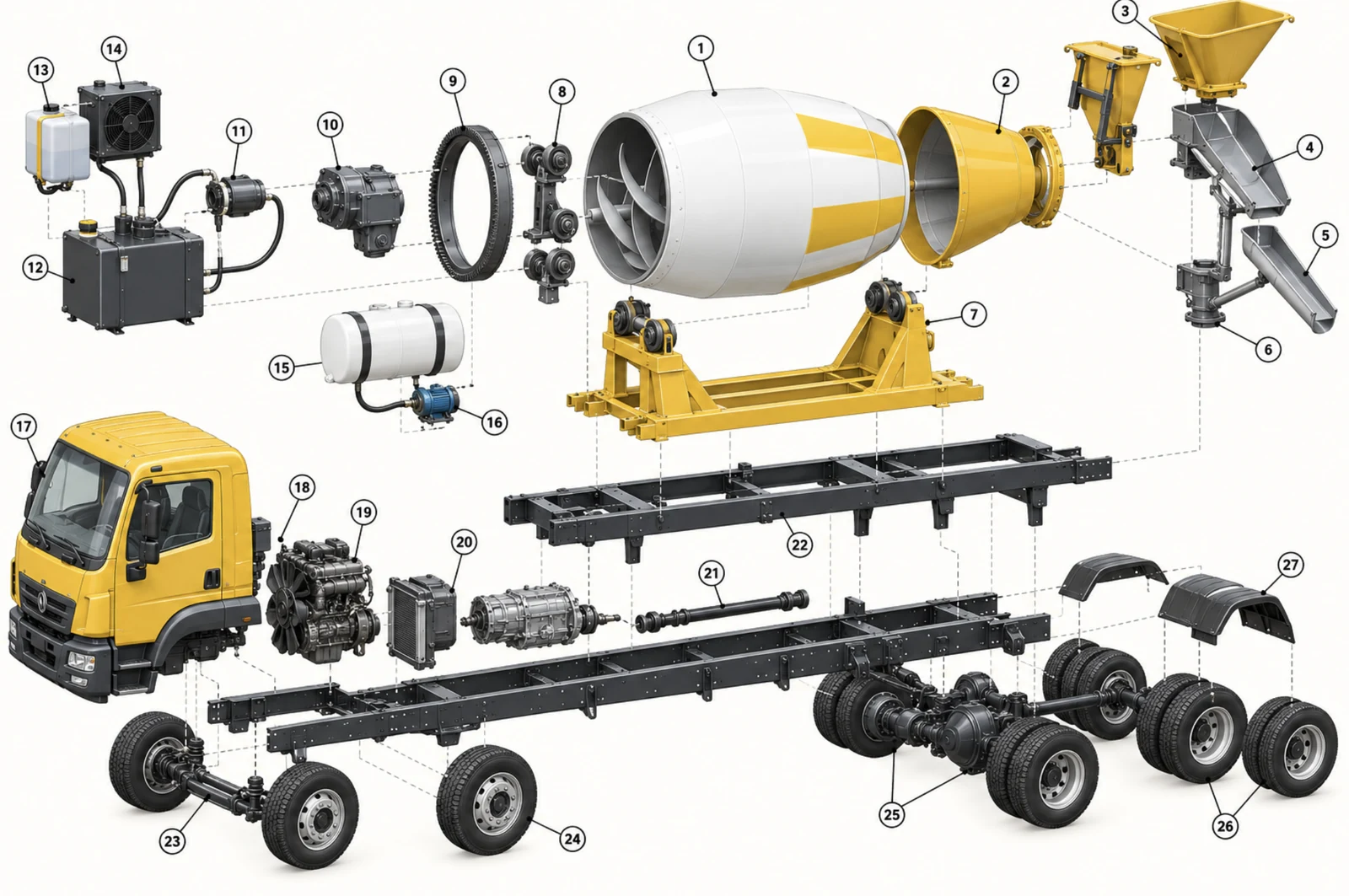
- 1Mixing drum with internal spiral blades
- 2Drum rear cone
- 3Charging hopper
- 4Discharge chute
- 5Folding extension chute
- 6Chute swivel bracket
- 7Drum pedestal and mounting frame
- 8Drum rollers
- 9Drum track ring
- 10Drum drive gearbox
- 11Hydraulic motor
- 12Hydraulic oil tank
- 13Oil expansion tank
- 14Oil cooler
- 15Water tank
- 16Water pump
- 17Truck cab
- 18Cooling fan
- 19Diesel engine
- 20Radiator and cooling pack
- 21Propeller shaft
- 22Sub-frame
- 23Front steer axle
- 24Wheels and tyres
- 25Rear drive axles
- 26Rear wheels and tyres
- 27Mudguards
What are the main parts of a transit mixer?
The dividing line runs along the sub-frame. Everything above it was built by a mixer maker. Everything below it was built by a truck maker. In India the two are very often different companies, which is why a mixer can carry one badge on the drum and another on the bonnet.
Here is the full layout, half by half:
- Mixer unit: drum, spiral blades, charging hopper, discharge chute, drum rollers and thrust bearing, sub-frame, water tank and pump, and the drum drive.
- Truck chassis: engine, clutch, gearbox, front and rear axles, suspension, brakes, steering, fuel and DEF tanks, wheels and cab.
The drum is what everyone looks at, but the sub-frame decides whether the machine lasts. It is a welded steel frame between the drum assembly and the truck’s chassis rails, spreading eight or ten tonnes of turning concrete along the frame instead of into two points. Sub-frames run from 3,896 mm to 6,700 mm long, matched to the drum above.
Parts naming carries across the family, so if you have already read the excavator parts guide or the guide to backhoe loader parts, the hydraulic and drivetrain sections here will feel familiar.
What are the parts of the mixer drum?
The drum is a steel shell shaped like a lemon, open at one end, mounted at an angle and turning on its own axis. Inside are two spiral blades welded to the shell in a helix, running the full length of the drum. They do all the work.
Turn the drum one way and the blades push concrete inward and upward, folding it over so it stays mixed. Reverse the drum and the same blades act like a screw, walking the concrete out towards the opening. That single reversal is the whole trick of a transit mixer, and it is why the machine needs no pump or gate to unload.
At the open end sit two more parts. The charging hopper is the funnel that guides concrete in from the batching plant. The discharge chute is the folding trough that guides it out, swivelling through a wide arc so the driver can place concrete without moving the truck. Chute extensions bolt on when the pour is further away.
Drum diameters are narrower than most buyers expect. Across all 31 mixer units listed, the drum measures 2,100 mm to 2,450 mm (2.1 to 2.45 metres) across at its widest point, and diameter barely moves with capacity. A Schwing Stetter AM 3 rated at 3 m³ runs a 2,100 mm drum; the 10 m³ machines run 2,260 mm to 2,300 mm. Bigger mixers get longer drums, not fatter ones, because the drum still has to pass under bridges and power lines. Mixer unit length runs from about 4.6 m on the smallest to over 8.5 m on the largest.
Shell thickness is the one drum figure worth asking about and the hardest to get. Nine of the listed units publish it, and none of them publish a single number. They publish a series, such as 3-4-5-6 mm or 4-5-6-8 mm. The shell is thicker where the concrete grinds hardest, so a drum that reads “5-8 mm” carries 8 mm of steel at its wear zone. Across the nine machines the thicknesses run from 3 mm to 8 mm. A thin shell is cheaper to buy and shorter to live with.
Why is the drum bigger than the concrete it carries?
Because concrete has to tumble to stay mixed, and it cannot tumble in a full drum. Every mixer therefore has three different volumes, and confusing them is the most common mistake buyers make when reading a spec sheet.
- Geometric volume: the total space inside the drum shell if you filled it to the brim. Across the listed units this runs 6,350 to 20,690 litres.
- Water-line volume: how much water the drum holds before it would spill out of the opening. Always less than geometric, because the drum is tilted and open at one end. Listed machines run 3,450 to 13,150 litres.
- Nominal capacity: the concrete the machine is actually rated and sold to carry. This is the “6 cubic metre” or “8 cubic metre” number on the badge.
The relationship between the first and the third is the filling ratio, and it is simply nominal capacity divided by geometric volume. On the machines listed for India it runs 47% to 61%. In plain terms: roughly half the drum is deliberately left empty so the concrete has room to fall.
| Machine | Rated capacity | Geometric volume | Water-line volume | Filling ratio | Drum diameter |
|---|---|---|---|---|---|
| Schwing Stetter AM 3 | 3.0 m³ | 6,350 L | 3,450 L | 47% | 2,100 mm |
| Universal | 6.0 m³ | 12,700 L | 7,300 L | 47% | 2,450 mm |
| Schwing Stetter AM 6 (C2) | 6.0 m³ | 11,580 L | 7,250 L | 52% | 2,300 mm |
| Venus 7.0 | 7.0 m³ | 13,250 L | 8,500 L | 55% | 2,350 mm |
| Conmat MR 70C | 7.0 m³ | 12,100 L | Not specified | 57.8% | 2,267 mm |
| AJAX AF 7XE | 7.0 m³ | 12,880 L | 8,183 L | 56% | 2,300 mm |
| Putzmeister P10 PTO | 10.0 m³ | 17,500 L | 10,800 L | 57.1% | 2,260 mm |
| Sunbeam 85 XL | 9.0 m³ | 14,600 L | Not specified | 61% | 2,200 mm |
Read the two 6 m³ rows together and the point becomes clear. Both carry the same rated load, but one uses a 2,450 mm drum at a 47% filling ratio and the other a 2,300 mm drum at 52%. The wider drum works its concrete more gently and takes more road space; the tighter one is more compact for the same output. Neither is wrong, and the number on the badge hides the choice.
For choosing a size rather than understanding one, the transit mixer capacity guide covers load weights and the truck each size needs.
What holds the drum up and turns it?
Three parts carry the drum, and each one is a known failure point.
At the front, closest to the cab, the drum sits on a gearbox and drive head that both turns it and supports its front end. At the back, the drum rides on rollers, free-spinning steel wheels mounted on the sub-frame that the drum’s rear track rests on. Almost every machine uses two rollers: of the 21 units publishing the figure, 20 run two, and a single 9 m³ machine runs four. A thrust bearing or thrust roller takes the sideways push, stopping a tilted drum from sliding down its own axis.
Rollers are cheap parts that cause expensive trouble. They wear as a pair with the drum’s rear track ring, and once the ring is worn the repair is welding on the drum itself, not a roller swap. Knocking from the rear of the drum while it turns empty is the sound to listen for.
Mixer unit weight matters here too, because it is dead weight the truck carries on every trip. Empty mixer units on the listed machines weigh 3,060 kg to 5,550 kg (3.06 to 5.55 tonnes), and that is before any concrete goes in. A heavier drum built from thicker steel lasts longer and costs payload every single day of its life.
How the drum is actually driven, by truck PTO, REPTO or a separate slave engine, is a decision worth its own read, and the transit mixer drum drive guide covers all three with the running-cost difference between them.
What is in the water system on a transit mixer?
The water system is four parts: a tank, a pump, a water line with nozzles into the drum and chute, and on some machines a water meter.
Its main job is washing. Concrete that dries inside a drum overnight comes out with a hammer, and every skipped wash permanently reduces the drum’s capacity. The tank feeds the nozzles so the driver can rinse the drum and chute the moment the load is out.
The pump is the part rarely mentioned in a sale and quickly missed on site. Of the units publishing the figures, water pumps run at 3.5 to 6 bar and deliver 250 to 560 litres per minute. That is enough to strip a wet film off steel, and no use at all once the pump seals have gone. A dead water pump turns a five-minute wash into a twenty-minute one.
The water meter, fitted on some machines with a 0–450 L or 0–600 L scale, records exactly how much water went into a load. Adding water on site to make stiff concrete easier to discharge is the single fastest way to ruin its strength, and a meter is what makes that visible rather than deniable.
Water tank sizes themselves are covered in the drum drive guide linked above, alongside the wash-out arrangement.
What are the parts of the truck under the mixer?
Ten complete truck-mounted mixers are listed, and their chassis parts are ordinary heavy-truck parts, which is good news: that is where India’s service network is deepest.
| Part | What is listed |
|---|---|
| Engine | 4 or 6 cylinder diesel, 5,000 cc to 7,698 cc; all ten BS-VI |
| Clutch | Single dry plate; 380 mm, 395 mm or 430 mm diameter |
| Gearbox | 6-speed or 9-speed synchromesh, manual |
| Front axle | Forged I-beam, reverse Elliot type on nine of ten |
| Rear axle | Single-reduction hypoid; tandem with inter-axle lock or differential lock |
| Chassis frame | 275–300 mm deep × 65–90 mm wide × 7–9 mm thick steel channel |
| Front suspension | Semi-elliptic or parabolic leaf springs |
| Rear suspension | Bogie, bell crank or non-reactive type |
| Brakes | Full-air, dual-line, S-cam drum brakes with ABS |
| Steering | Hydraulic power assisted, tilt and telescopic column |
| Fuel tank | 220 L to 300 L |
| DEF tank | 24 L to 60 L |
| Battery | 12 V 180 Ah, or two 12 V batteries giving 24 V at 110–150 Ah |
| Gross vehicle weight | 28,000 kg on eight; 35,000 kg on two |
| Wheelbase | 3,880 mm to 5,285 mm |
Two of these deserve a note. The DEF tank holds diesel exhaust fluid, the urea solution BS-VI engines inject into the exhaust to clean it; run it dry and the engine derates itself, which on a loaded mixer with a setting clock running is a serious problem. And the chassis frame figure, giving depth, width and thickness, tells you whether the truck was built for this duty, because a mixer applies a twisting load no tipper ever does.
The number of axles is set by the drum on top. Of the 31 mixer units listed, three are built for 2-axle trucks, twenty-two for 3-axle and five for 4-axle. Below about 4 m³ a two-axle truck carries the load; above 8 m³ you are usually looking at four axles and a 35-tonne gross weight.
Which transit mixer parts wear out first in India?
The wear list is short and predictable, because only a few transit mixer parts are in constant contact with wet concrete and grit.
- Spiral blades: they grind against every load. Worn blades stop discharging cleanly and leave concrete in the drum, which then hardens. This is the biggest wear item on the machine.
- Drum rollers and the thrust bearing: cheap to replace on time, expensive once the drum’s track ring has worn with them.
- Discharge chute and extensions: steel that concrete slides across all day, and the part most often patched rather than replaced.
- Water pump and seals: small, ignored, and the reason a drum stops getting washed properly.
- Hydraulic hoses at the drive head: they flex constantly and sit where leaks are easy to miss.
- Clutch and gearbox on PTO machines: because the truck’s own driveline turns the drum, a PTO mixer works its clutch far harder than a tipper does.
Dust, long site waits and summer heat shorten every one of these intervals in India. Greasing on schedule is what stretches them. The greasing and lubrication guide covers grades and intervals, and the service schedule guide sets out what gets checked at each hour mark.
How do you check these parts before buying?
Run the drum through a full cycle, both directions, empty, and stand at the back while it turns. Listen for knocking from the rollers, and watch for a drum that wobbles rather than turning true.
Then look inside with a torch. Blades should have a clean edge, not a rounded one, and there should be no hardened concrete built up along the shell. A build-up means the machine has been going home dirty, and losing capacity with every load. Check the chute for patch welds and the sub-frame for cracks where it meets the chassis rails.
Watch the dashboard through its self-test while you are at it, because a lamp that never lights has usually been disconnected. Our guide to transit mixer warning lights and dashboard symbols covers the truck panel and the drum-drive panel separately.
On the truck half, treat it as you would any heavy commercial vehicle: brakes, tyres, leaks, smoke and papers. Buying second-hand adds a longer list of checks, hours and price questions, and the used transit mixer buying guide works through those.
If you are still deciding between a truck-mounted mixer and a machine that batches its own concrete, the comparison in the self-loading mixer versus transit mixer guide is the place to start, and the guide to how transit mixers work covers the mixing cycle itself.
Ready to look at machines? Compare live transit mixer and concrete mixer models and connect with a dealer near you.
A note on the figures in this guide
Every number above comes from the specification sheets of the 41 transit mixers listed for India at the time of writing, not from a brochure or a parts catalogue. Where a figure is published by only some of those machines, the count is stated so you can judge it yourself.
One figure was deliberately left out. A 12 m³ machine publishes a filling ratio of 79%, which does not agree with its own rated capacity and drum volume. Those two give 58%, in line with every other machine listed. The published 47% to 61% band above therefore excludes it, and the discrepancy has been raised for correction. Where a specification and a machine’s own other figures disagree, we leave the number out rather than guess which one is right.
Two more limits. Prices for transit mixer parts are not covered here, because parts are not listed as products and any figure would be invented; the spare parts guide covers what to check before you buy them instead. And parts naming varies between makers: what one calls a thrust roller another calls a thrust bearing, and both are the same part doing the same job.
Related reading across the same series: road roller parts, Hydra and Farana crane parts, and the full parts and running costs guide.
On a site where the mixer feeds a pump rather than the pour directly, the machine at the other end has its own parts list, set out in the guide to concrete pump parts and components.
The self-loading machine at the other end of the mixer family carries a different parts list, including its own charging bucket and on-board weighing system, set out in the guide to self-loading concrete mixer parts and components.
Prices, specifications and features are indicative, vary by variant, location and date, and should always be confirmed with the official OEM or authorised dealer before any purchase decision. DesiMachines is not liable for decisions taken on the basis of information that may have changed after publication.
Machines, tenders and news for this industry: Ready-Mix Concrete